
If you are buying land, studying property measurements, or comparing lot sizes, you may ask: how many feet is 1 acre?
This is a very common question—but it contains a small misunderstanding.
An acre is not measured in straight feet. Instead, it measures area, not length.
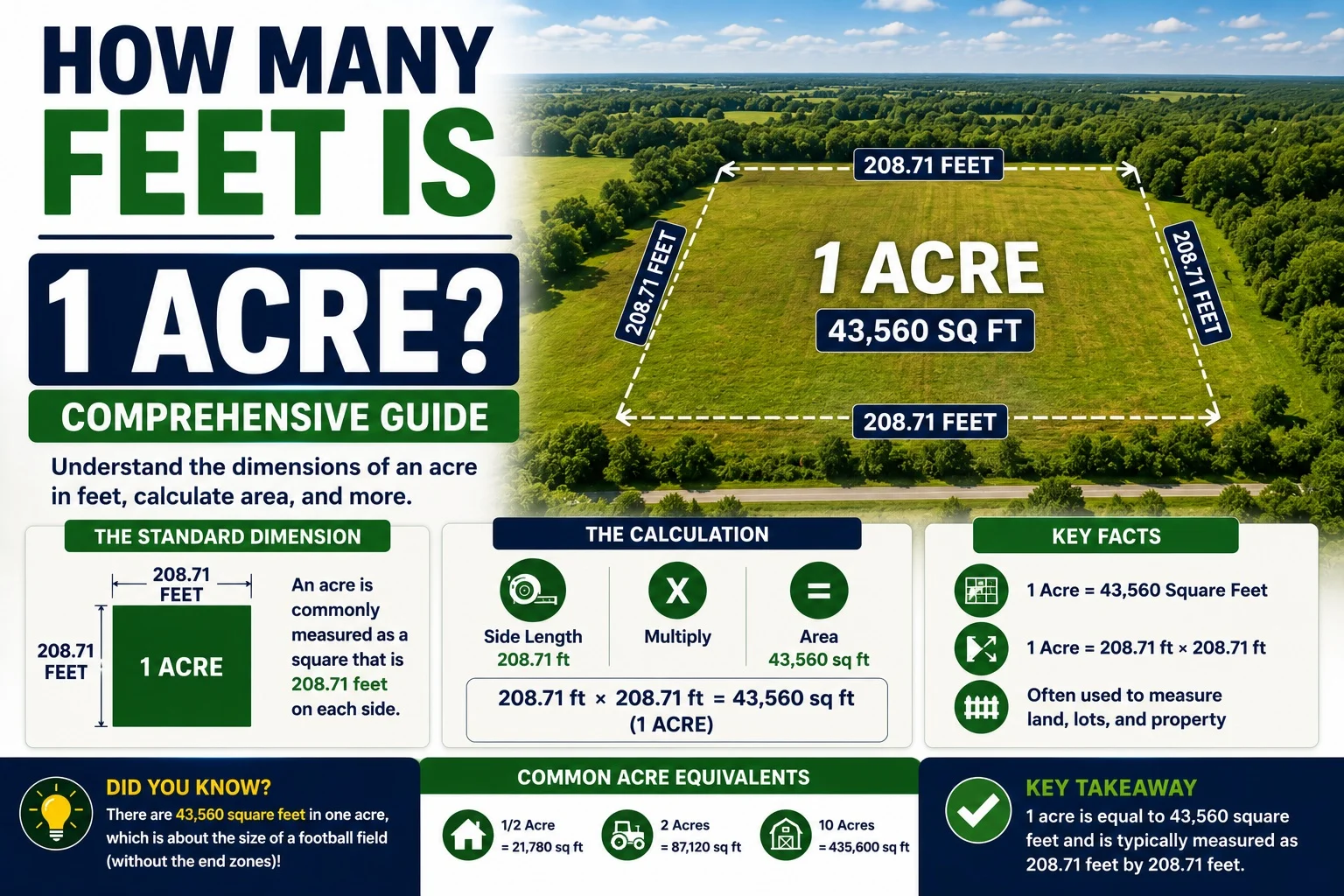
1 acre equals 43,560 square feet.
So the correct way to express it is not “feet,” but square feet.
Quick Answer
Standard land conversion:
1 acre=43,560 square feet
Final Answer:
1 acre = 43,560 square feet of land area
Why “Feet” Is Not the Right Unit
A “foot” measures length.
An acre measures area, which is two-dimensional:
- length × width
So asking “how many feet is 1 acre” is like asking:
- How many inches is a room?
You must convert it into square feet to be accurate.
What an Acre Actually Measures
An acre is a standardized land measurement used in:
- Real estate
- Farming
- Construction
- Land surveying
It does NOT depend on shape.
An acre can be:
- A long rectangle
- A perfect square
- An irregular field
But the total area always equals the same number of square feet.
Exact Square Foot Conversion
The official conversion is:
43,560 square feet
So:
- 1 acre = 43,560 sq ft
- 2 acres = 87,120 sq ft
- 10 acres = 435,600 sq ft
Visualizing 1 Acre
It can be difficult to imagine 43,560 square feet.
A common way to visualize it is a square:
208.7 ft×208.7 ft
So one acre is roughly:
A square about 209 feet by 209 feet
Common Acre Shapes
Even though we visualize a square, real land is rarely perfectly shaped.
1 acre could be:
- 100 ft × 435.6 ft (long rectangle)
- 50 ft × 871.2 ft (very long strip)
- Irregular farmland shape
The shape does not change the total area.
Acre Compared to Real-World Examples
🏈 Football Field
A standard football field (with end zones) is about:
57,600 square feet
So:
- 1 acre is about 75% of a football field
🏡 Residential Lots
A typical suburban home lot may be:
- 0.2 to 0.5 acres
So:
- 1 acre can hold multiple homes depending on zoning
🌳 Parks and Land
Many small parks are 1–5 acres in size.
Why Acres Are Used in Real Estate
Acres are used because they are:
- Easier for large land areas
- Standardized in agriculture
- Easier than writing large square foot numbers
Instead of saying:
- 43,560 square feet
People simply say:
- 1 acre
Common Mistakes
❌ Confusing feet with square feet
Feet = length
Square feet = area
❌ Assuming acre has fixed shape
It does not.
❌ Thinking acreage changes with terrain
Slopes do not change area measurement.
Why Understanding Acre Size Matters
Knowing how many feet is 1 acre helps with:
- Buying land
- Comparing property listings
- Planning construction
- Estimating farming space
- Understanding zoning laws
It prevents overestimating or underestimating land size.
FAQs
1. How many feet is 1 acre?
An acre is not measured in feet. It equals 43,560 square feet.
2. How big is 1 acre in simple terms?
About the size of a football field minus about 25%.
3. What are the dimensions of 1 acre?
One common square approximation is:
- 209 ft × 209 ft
4. Why don’t we measure acres in feet?
Because feet measure length, not area.
5. Is 1 acre a big piece of land?
Yes, it is large enough for homes, farming, or small development.
Conclusion
So, how many feet is 1 acre?
The correct answer is:
1 acre = 43,560 square feet
While people often ask in “feet,” acreage is actually a measurement of area, not length. Understanding this distinction helps you better interpret land sizes, real estate listings, and property layouts with confidence.