

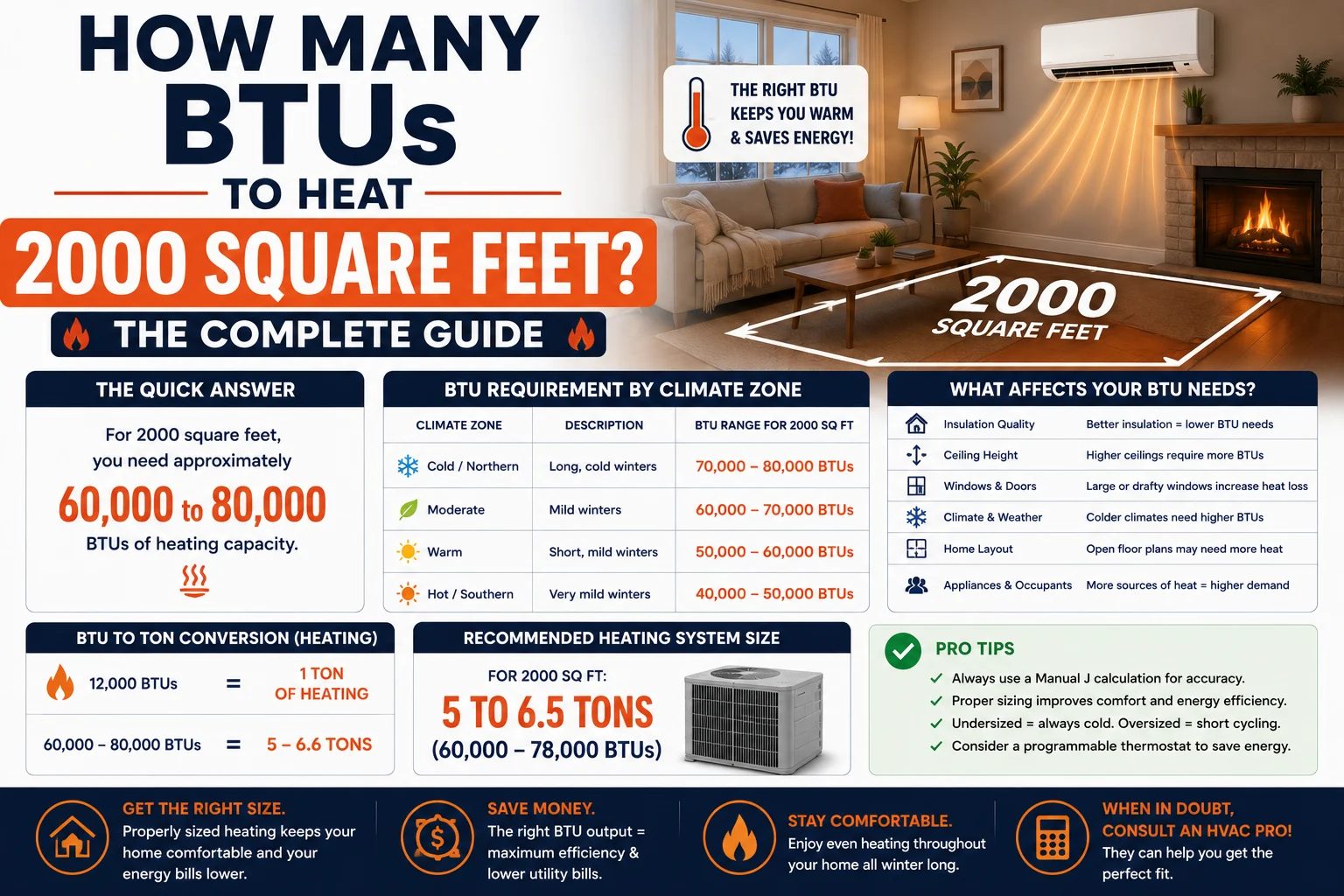
If you’re planning to heat a home, office, or large space, one of the most important questions is: how many BTUs to heat 2000 square feet?
Choosing the right heating capacity is critical. Too small, and your space stays cold. Too large, and you waste energy and money.
A 2000 square foot home typically needs between 40,000 and 60,000 BTUs for efficient heating.
This range changes based on insulation, climate, ceiling height, and building efficiency.
Quick Answer
The standard HVAC guideline is:
20 to 30 BTUs per square foot
Now apply it to 2000 square feet:
2000×20=40000 BTUs (low end)
2000×30=60000 BTUs (high end)
Final Range:
40,000 to 60,000 BTUs
What Is a BTU?
BTU stands for:
British Thermal Unit
It measures heat energy required to:
1 BTU=heatneededtoraise1poundofwaterby1°F
In HVAC systems:
- Higher BTU = more heating power
- Lower BTU = less heating capacity
Standard BTU Per Square Foot Rule
Most heating systems use:
20 to 30 BTUs per square foot
This depends on:
- Climate zone
- Insulation quality
- Window size
- Ceiling height
- Home age
How Many BTUs for 2000 Square Feet?
Step-by-step calculation:
Low estimate:
2000×20=40000
High estimate:
2000×30=60000
Final answer:
40,000–60,000 BTUs
Climate-Based BTU Adjustments
Warm climates
- 20 BTU per sq ft
- Lower heating demand
Moderate climates
- 25 BTU per sq ft
- Average heating need
Cold climates
- 30+ BTU per sq ft
- Higher heating requirement
Example:
A 2000 sq ft home in a cold region may need:
- 60,000+ BTUs
Insulation and Efficiency Factors
Good insulation
- Retains heat well
- Lower BTU requirement
Poor insulation
- Heat loss through walls/windows
- Higher BTU requirement
Ceiling height
- Higher ceilings increase air volume
- Require more BTUs
Window quality
- Single-pane windows increase heat loss
Furnace and Heater Sizing Chart
| Home Condition | BTUs Needed |
|---|---|
| Well insulated home | 40,000 |
| Average insulation | 45,000–55,000 |
| Poor insulation / cold climate | 60,000+ |
Real-World Heating Scenarios
Modern Energy-Efficient Home
2000×20=40000 BTUs
Average Suburban Home
2000×25=50000 BTUs
Older Home in Cold Climate
2000×30=60000 BTUs
Common Mistakes in BTU Sizing
Undersizing the furnace
- Leads to cold rooms
- Overworked heating system
Oversizing equipment
- Higher energy bills
- Short cycling issues
Ignoring insulation quality
- Biggest source of miscalculation
Not considering climate zone
- Can cause major sizing errors
Expert HVAC Recommendations
Always perform a heat load calculation
Professional HVAC sizing is more accurate.
Consider future upgrades
Better insulation reduces BTU needs.
Choose variable-speed systems
More efficient temperature control.
Add a safety buffer only when needed
Avoid unnecessary oversizing.
Why BTU Calculation Matters
Understanding how many BTUs to heat 2000 square feet helps you:
- Choose the correct furnace size
- Reduce energy costs
- Improve comfort levels
- Avoid equipment failure
- Extend HVAC lifespan
FAQs
1. How many BTUs do I need for 2000 sq ft?
Typically 40,000 to 60,000 BTUs.
2. What size furnace for 2000 sq ft?
A 40,000–60,000 BTU furnace is standard.
3. Does insulation affect BTU needs?
Yes, significantly.
4. Is higher BTU always better?
No, it can reduce efficiency.
5. Can one system heat 2000 sq ft?
Yes, if properly sized.
Conclusion
So, how many BTUs to heat 2000 square feet? The typical requirement is 40,000 to 60,000 BTUs, depending on climate, insulation, and home design.
By understanding BTU sizing principles, you can choose an efficient heating system that keeps your home comfortable while minimizing energy costs and avoiding oversizing mistakes.