

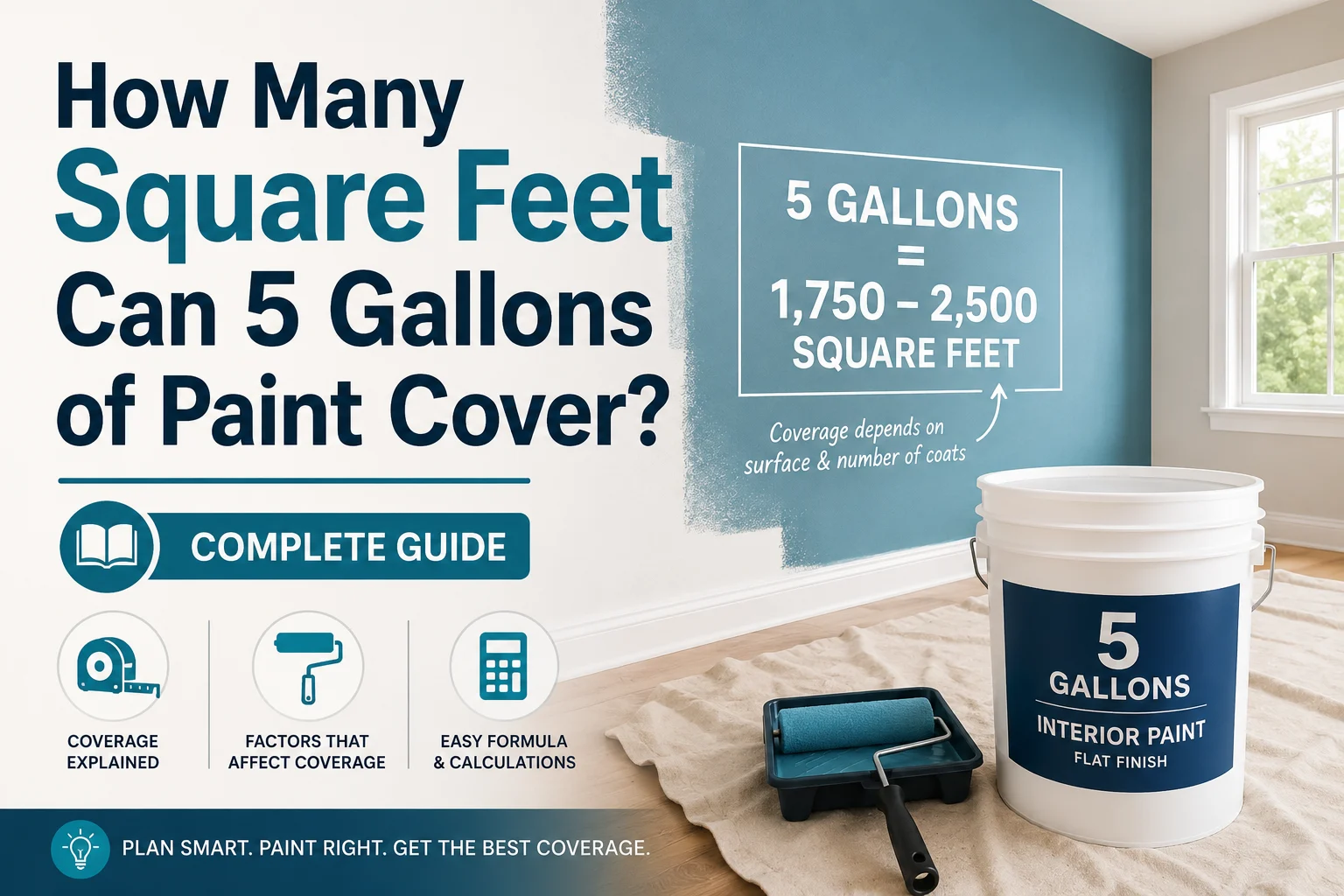
If you are planning a home renovation or painting project, you may be wondering: how many square feet can 5 gallons of paint cover?
The simple answer is:
5 gallons of paint typically covers about 1,500 to 2,000 square feet.
However, the exact coverage depends on the surface, paint type, number of coats, and application method.
In this guide, you’ll learn how paint coverage works, how to calculate your needs, and how to avoid common mistakes when estimating paint for your project.
Quick Answer
The average coverage of 5 gallons of paint is:
1500 to 2000 square feet
Breakdown:
- 1 gallon of paint ≈ 300–400 sq ft
- 5 gallons ≈ 1,500–2,000 sq ft
Understanding Paint Coverage
Paint coverage is measured in:
Square feet per gallon (sq ft/gal)
This tells you how much surface area one gallon of paint can cover.
Standard rule:
1 \text{ gallon} \approx 350 \text{ square feet (average coverage)
So paint manufacturers typically assume:
- Smooth, primed wall
- One coat
- Normal thickness
How Many Square Feet Can 5 Gallons of Paint Cover?
Now let’s calculate it clearly.
Step 1: Average coverage per gallon
300 to 400 sq ft per gallon
Step 2: Multiply by 5 gallons
5×300=1500 sq ft
5×400=2000 sq ft
Final Answer
5 gallons=1500 to 2000 square feet
Paint Coverage Chart
| Gallons | Coverage (sq ft) |
|---|---|
| 1 gallon | 300–400 sq ft |
| 2 gallons | 600–800 sq ft |
| 3 gallons | 900–1,200 sq ft |
| 5 gallons | 1,500–2,000 sq ft |
Factors That Affect Paint Coverage
1. Surface Type
- Smooth drywall = best coverage
- Rough brick or stucco = less coverage
2. Number of Coats
- One coat = maximum coverage
- Two coats = reduces coverage by half
3. Paint Quality
- High-quality paint spreads further
- Cheap paint requires more product
4. Color Change
- Light-to-dark transitions require more paint
- Dark-to-light often needs primer
5. Application Method
- Roller = standard coverage
- Spray = more even but uses more paint
- Brush = least efficient for large areas
Real-World Painting Examples
Example 1: Small Apartment
- 800 sq ft walls
- 2 coats needed
👉 5 gallons is usually enough
Example 2: Medium House Interior
- 1,500 sq ft walls
- 1–2 coats
👉 5 gallons is borderline sufficient
Example 3: Large House Exterior
- 2,000+ sq ft surface
- Requires 2 coats
👉 May need 7–10 gallons
How to Calculate Paint Needed
Use this simple formula:
Paint needed=350Total surface area
Then divide by 350 (average coverage per gallon).
Common Mistakes When Estimating Paint
1. Ignoring surface texture
Rough walls absorb more paint.
2. Forgetting second coat
Most projects require two coats.
3. Not measuring properly
People often underestimate wall area.
4. Skipping primer
Primer changes total paint requirements.
Expert Painting Tips
- Always buy 10–15% extra paint
- Use primer for better coverage
- Measure walls carefully before buying
- Use high-quality rollers for efficiency
- Mix all paint cans together for consistent color
Pro Tip:
It’s better to have extra paint than run short mid-project.
Why Paint Coverage Matters
Understanding how many square feet can 5 gallons of paint cover helps you:
- Avoid wasting money
- Prevent mid-project shortages
- Plan renovations accurately
- Estimate labor and materials
- Improve finishing quality
Proper estimation ensures smoother and more professional results.
5 FAQs
1. How many square feet can 5 gallons of paint cover?
About 1,500 to 2,000 square feet.
2. How much does 1 gallon of paint cover?
Roughly 300 to 400 square feet.
3. Is 5 gallons enough for a house?
It depends on house size—usually for small to medium rooms or partial painting.
4. Does paint cover more on smooth walls?
Yes, smooth surfaces require less paint.
5. Do you need 2 coats of paint?
Yes, most projects require two coats for best results.
Conclusion
So, how many square feet can 5 gallons of paint cover? The typical range is 1,500 to 2,000 square feet, depending on surface type, paint quality, and number of coats.
A 5-gallon bucket is usually enough for medium-sized interior projects, but planning carefully is essential for accurate results.
By understanding coverage rates, you can estimate paint more effectively, save money, and achieve a smoother, more professional finish.