
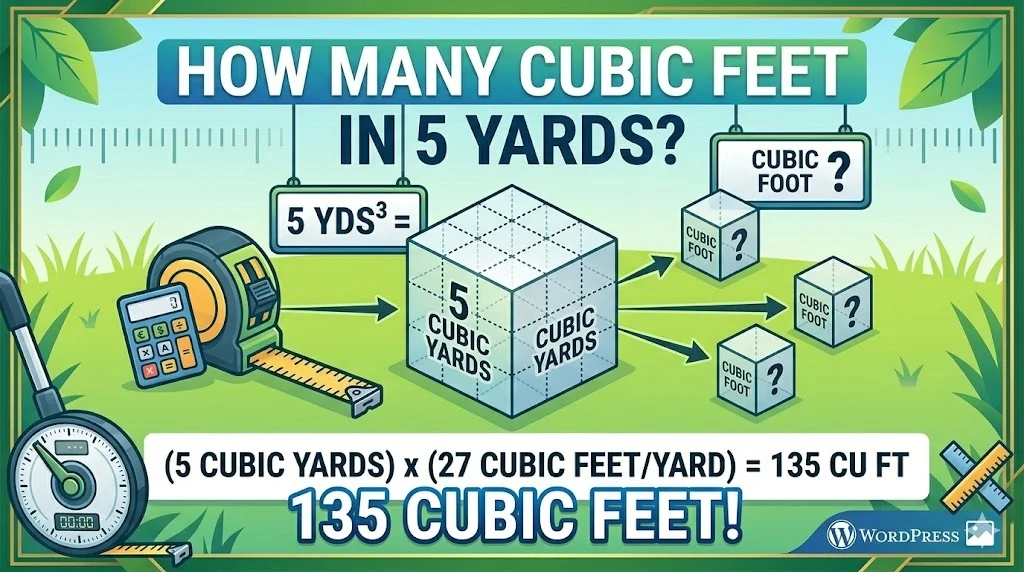
If you are working on a landscaping, construction, or home improvement project, you may ask: how many cubic feet in 5 yards?
The answer is:
5 cubic yards=135 cubic feet
Since one cubic yard equals 27 cubic feet, multiplying by 5 gives a total of 135 cubic feet.
This conversion is extremely useful for:
- Mulch calculations
- Concrete projects
- Soil delivery
- Gravel estimation
- Construction planning
In this guide, you will learn:
- How cubic yard conversions work
- Easy formulas to remember
- Real-world project examples
- Common conversion mistakes
- Helpful estimating tips
By the end, you will clearly understand how much space 5 cubic yards occupies and how to use that measurement in practical situations.
Quick Answer to the Conversion
Basic Formula
The standard conversion formula is:
1 cubic yard=27 cubic feet
To convert 5 cubic yards:
5×27=135 cubic feet
Final Answer
So, the complete answer is:
- 5 cubic yards = 135 cubic feet
This measurement represents volume, not length or area.
Volume measures:
- Width
- Height
- Depth
combined into three-dimensional space.
Understanding Cubic Yards and Cubic Feet
Before converting measurements, it helps to understand what these units mean.
What Is a Cubic Yard?
A cubic yard is a cube measuring:
3 ft×3 ft×3 ft
Because:
- 3 × 3 × 3 = 27
one cubic yard contains:
- 27 cubic feet
Cubic yards are commonly used for:
- Concrete
- Gravel
- Sand
- Soil
- Mulch
What Is a Cubic Foot?
A cubic foot is:
- A cube measuring 1 foot on each side
It represents a smaller unit of volume.
Cubic feet are often used for:
- Appliance capacity
- Small material quantities
- Storage measurements
- Packaging dimensions
Conversion Formula Explained
The conversion process is simple.
Use this formula:
Cubic Feet=Cubic Yards×27
Example for 5 yards:
5×27=135
This formula works for any cubic yard conversion.
Cubic Yards to Cubic Feet Conversion Chart
Here is a quick reference table.
| Cubic Yards | Cubic Feet |
|---|---|
| 1 yard | 27 cubic feet |
| 2 yards | 54 cubic feet |
| 3 yards | 81 cubic feet |
| 5 yards | 135 cubic feet |
| 10 yards | 270 cubic feet |
This chart helps estimate project material needs quickly.
Real-World Examples of 5 Cubic Yards
It can be difficult to visualize 135 cubic feet, so real examples help.
Mulch Projects
Five cubic yards of mulch can cover:
- A large garden bed
- Multiple landscaping areas
- Around 1,600 square feet at 1-inch depth
This makes it common for residential landscaping projects.
Concrete Jobs
A concrete truck delivering 5 cubic yards may handle:
- Small patios
- Sidewalks
- Driveways
- Shed foundations
Concrete volume calculations are critical because ordering too little or too much can become expensive.
Soil and Gravel
Five cubic yards of soil or gravel can fill:
- Raised garden beds
- Drainage trenches
- Backyard leveling projects
The exact coverage depends on depth.
Why Volume Conversion Matters
Volume conversions are essential for accurate planning.
Construction Planning
Contractors use cubic measurements to estimate:
- Concrete needs
- Excavation volumes
- Backfill materials
- Dump truck loads
Accurate conversions prevent waste and delays.
Landscaping Accuracy
Landscapers calculate:
- Mulch quantities
- Soil depth
- Gravel coverage
- Stone distribution
Incorrect estimates can increase project costs.
Material Cost Estimation
Many suppliers price materials by:
- Cubic yard
- Cubic foot
- Truckload volume
Knowing conversions helps compare prices accurately.
Common Mistakes When Converting Cubic Yards
People often make simple errors during conversions.
Confusing Square Feet With Cubic Feet
Square feet measure area.
Cubic feet measure:
- Area plus depth
This is one of the most common mistakes.
Forgetting the Number 27
Always remember:
1 cubic yard=27 cubic feet
Many conversion mistakes happen because people forget this number.
Ignoring Material Depth
Coverage changes depending on thickness.
For example:
- 5 cubic yards spread thin covers more area
- Spread deep covers less area
Depth matters greatly in landscaping calculations.
How to Estimate Cubic Yards for Projects
You can estimate material needs using dimensions.
Step-by-Step Formula
Measure:
- Length
- Width
- Depth
Then calculate volume.
Formula:
Volume=Length×Width×Depth
After finding cubic feet, divide by 27 to convert into cubic yards.
Example Project
Suppose you need soil for:
- 15 feet long
- 9 feet wide
- 1 foot deep
The volume becomes:
15×9×1=135 cubic feet
Then convert:
135÷27=5 cubic yards
This shows exactly how 5 cubic yards may appear in a real project.
Expert Tips for Measuring Volume
Round Up Slightly
Always order slightly more material than estimated.
This helps avoid shortages during projects.
Double-Check Depth
Incorrect depth calculations create major estimation problems.
Even a small depth error can greatly change volume.
Use Consistent Units
Keep all measurements in:
- Feet
- Inches
- Yards
Mixing units causes conversion mistakes.
Understand Material Compaction
Some materials settle after installation.
Examples:
- Soil
- Mulch
- Gravel
You may need additional material after compaction.
FAQs
1. How many cubic feet are in 5 cubic yards?
There are exactly 135 cubic feet in 5 cubic yards.
2. What is the formula for converting cubic yards to cubic feet?
Use this formula:
Cubic Feet=Cubic Yards×27
3. Why does one cubic yard equal 27 cubic feet?
Because:
- 1 yard = 3 feet
So:
3×3×3=27
4. Is 5 cubic yards a lot of material?
Yes. Five cubic yards is a substantial amount commonly used for landscaping and small construction projects.
5. How much area does 5 cubic yards cover?
Coverage depends on depth. At 1-inch depth, 5 cubic yards can cover roughly 1,600 square feet.
Conclusion
So, how many cubic feet in 5 yards? The exact answer is 135 cubic feet.
Understanding cubic yard conversions helps with:
- Landscaping projects
- Construction planning
- Material estimation
- Budget calculations
- DIY improvements
Whether you are ordering mulch, pouring concrete, spreading gravel, or planning a garden, knowing how to convert cubic yards into cubic feet helps you complete projects more accurately and efficiently.