

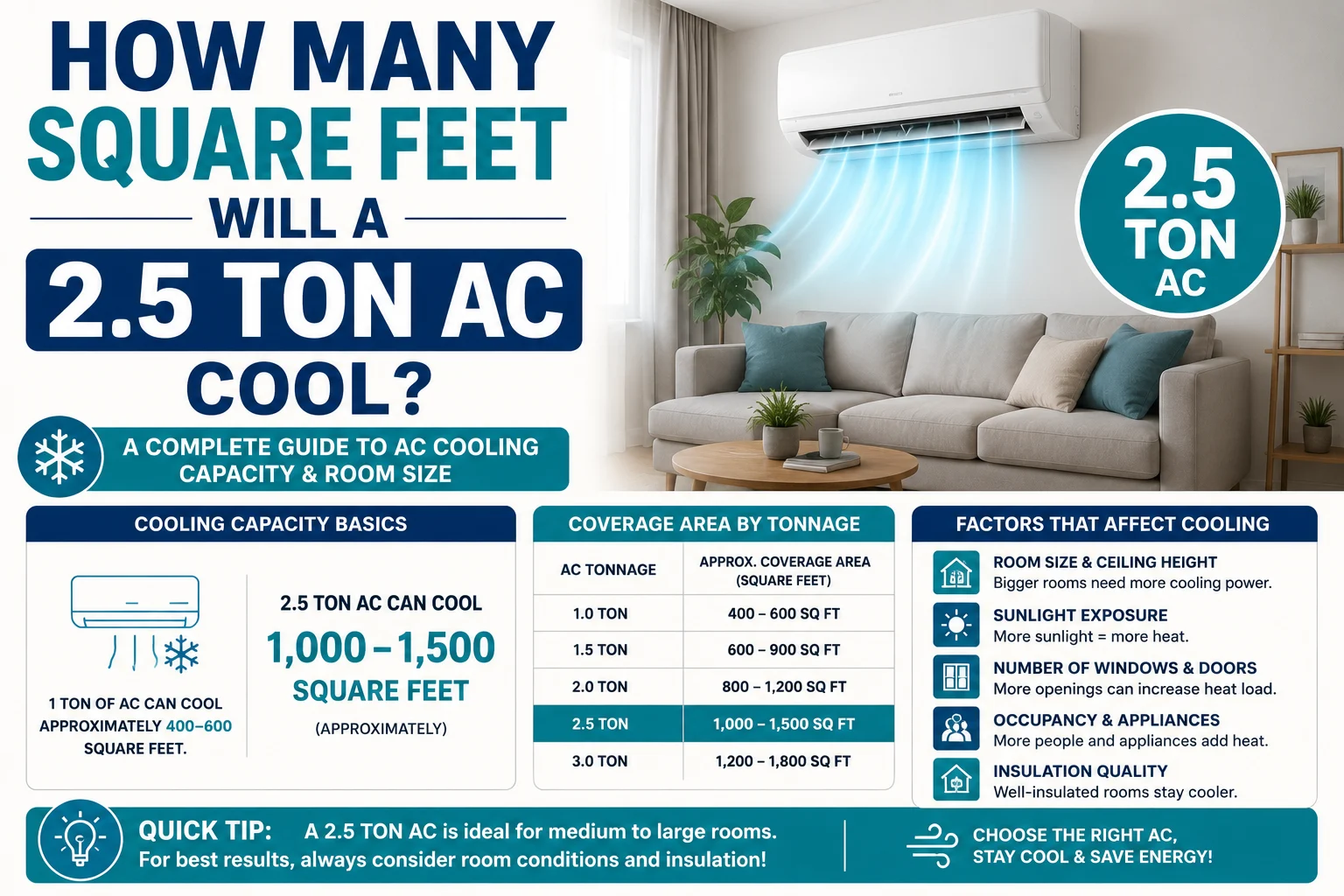
If you are shopping for a new air conditioner or upgrading your HVAC system, one of the most common questions is:
“How many square feet will a 2.5 ton AC cool?”
Choosing the correct air conditioner size is extremely important for comfort, energy efficiency, and long-term performance. An AC unit that is too small may struggle to cool your home, while an oversized system can waste energy and create humidity problems.
In general:
A 2.5 ton air conditioner can cool approximately 1,200 to 1,500 square feet under normal conditions.
However, the exact cooling coverage depends on several factors, including:
- Climate
- Insulation
- Ceiling height
- Sun exposure
- Window size
- Home layout
- Occupancy
In this complete guide, you will learn:
- What a 2.5 ton AC means
- How many square feet it can cool
- BTU calculations
- Factors affecting cooling performance
- Room-by-room examples
- HVAC sizing tips
- Common mistakes to avoid
- Frequently asked questions
Let’s get started.
Quick Answer: How Many Square Feet Will a 2.5 Ton AC Cool?
A standard estimate is:
A 2.5 ton AC cools about 1,200 to 1,500 square feet.
This assumes:
- Average insulation
- Standard 8-foot ceilings
- Moderate climate
- Typical residential construction
What Does “2.5 Ton AC” Mean?
In HVAC terminology, “ton” does not refer to weight.
It refers to cooling capacity.
One Ton of AC Equals:
1 ton=12,000 BTUs per hour
So a 2.5 ton AC provides:
2.5×12000=30000 BTUs per hour
Result:
A 2.5 ton air conditioner produces 30,000 BTUs of cooling power per hour.
BTU Coverage Formula
A common HVAC estimate uses:
- 20 BTUs per square foot
Using this formula:
30000÷20=1500 square feet
This gives the maximum estimated cooling area under ideal conditions.
Typical Cooling Range for a 2.5 Ton AC
| Home Conditions | Estimated Coverage |
|---|---|
| Excellent insulation | 1,500 sq ft |
| Average insulation | 1,300–1,400 sq ft |
| Hot climate or poor insulation | 1,200 sq ft |
Factors That Affect Cooling Coverage
Not every home cools the same way.
Several important factors influence AC sizing.
1. Climate Zone
Hot Climates
Homes in hotter areas need more cooling power.
Examples:
- Arizona
- Texas
- Florida
A 2.5 ton AC may cool:
- Closer to 1,200 sq ft
Mild Climates
Cooler regions may allow:
- Up to 1,500 sq ft coverage
2. Insulation Quality
Well-insulated homes retain cool air more efficiently.
Good Insulation
Benefits:
- Lower energy bills
- Better cooling performance
- Larger effective coverage area
Poor Insulation
Problems:
- Heat enters faster
- AC runs longer
- Reduced cooling efficiency
3. Ceiling Height
Most sizing estimates assume:
- 8-foot ceilings
Higher ceilings increase room volume.
Example
A home with:
- 12-foot ceilings
May require:
- More cooling capacity
Even if square footage remains the same.
4. Sun Exposure
Sunlight significantly affects indoor temperatures.
South- and West-Facing Homes
Often require:
- Additional cooling capacity
Large windows can increase heat gain substantially.
5. Number of Occupants
People generate body heat.
Homes with:
- Large families
- Frequent gatherings
May need more cooling power.
6. Appliances and Electronics
Heat-producing devices include:
- Ovens
- Computers
- TVs
- Gaming systems
More electronics can increase AC load.
Real-World Examples
Understanding practical examples makes sizing easier.
Small House
Home size:
- 1,250 sq ft
Conditions:
- Good insulation
- Moderate climate
Result:
A 2.5 ton AC should perform well.
Hot Climate Home
Home size:
- 1,450 sq ft
Conditions:
- Hot climate
- Large windows
- Poor insulation
Result:
A 2.5 ton unit may struggle.
A larger system could be needed.
Energy-Efficient Home
Home size:
- 1,500 sq ft
Conditions:
- Modern insulation
- Energy-efficient windows
- Shade trees
Result:
A 2.5 ton AC may cool efficiently.
Why Proper AC Sizing Matters
Correct sizing improves:
- Comfort
- Humidity control
- Energy efficiency
- Equipment lifespan
Problems With an Undersized AC
A unit that is too small may:
- Run constantly
- Fail to cool properly
- Increase energy costs
- Wear out faster
Problems With an Oversized AC
An oversized unit may:
- Short cycle frequently
- Waste electricity
- Leave humidity indoors
- Create uneven temperatures
Bigger is not always better.
SEER Ratings and Efficiency
Besides tonnage, efficiency matters.
SEER Rating
SEER stands for:
- Seasonal Energy Efficiency Ratio
Higher SEER ratings usually mean:
- Lower energy bills
- Better efficiency
Common AC Sizes and Coverage
| AC Size | BTUs | Estimated Coverage |
|---|---|---|
| 1 ton | 12,000 | 500–600 sq ft |
| 1.5 ton | 18,000 | 700–900 sq ft |
| 2 ton | 24,000 | 1,000–1,200 sq ft |
| 2.5 ton | 30,000 | 1,200–1,500 sq ft |
| 3 ton | 36,000 | 1,500–1,800 sq ft |
| 4 ton | 48,000 | 2,000–2,400 sq ft |
Central AC vs Mini Split Systems
A 2.5 ton capacity can be used in:
- Central HVAC systems
- Mini split systems
- Heat pumps
Central Air Systems
Typically cool:
- Entire homes
Require:
- Ductwork
Mini Splits
Advantages:
- Zoned cooling
- Energy efficiency
- Quiet operation
Good for:
- Additions
- Garages
- Apartments
How HVAC Professionals Size AC Units
Professionals use:
- Manual J calculations
These calculations consider:
- Insulation
- Climate
- Windows
- Orientation
- Air leakage
- Occupancy
- Building materials
This is more accurate than square-foot estimates alone.
Energy-Saving Tips for a 2.5 Ton AC
Improve Insulation
Better insulation reduces cooling demand.
Seal Air Leaks
Prevent cool air from escaping.
Use Ceiling Fans
Fans improve comfort and air circulation.
Install Window Coverings
Curtains and blinds reduce heat gain.
Maintain HVAC Filters
Dirty filters reduce airflow and efficiency.
Signs Your AC May Be the Wrong Size
Warning Signs
- Constant running
- Uneven temperatures
- High humidity
- High utility bills
- Frequent cycling
These issues may indicate improper sizing.
Common Mistakes When Choosing AC Size
Choosing Based Only on Square Footage
Many other factors matter.
Ignoring Climate
Hot regions require more cooling.
Oversizing the System
Oversized systems can reduce comfort.
Forgetting Ceiling Height
Tall ceilings increase air volume.
FAQs
How many square feet does a 2.5 ton AC cool?
Usually:
- 1,200 to 1,500 square feet
How many BTUs is a 2.5 ton AC?
A 2.5 ton AC equals:
- 30,000 BTUs per hour
Is a 2.5 ton AC enough for a 1,400 sq ft house?
In many cases, yes.
However:
- Climate
- Insulation
- Sun exposure
Also matter.
Can a 2.5 ton AC cool 1,600 square feet?
Possibly in mild climates with excellent insulation, but it may be undersized in hotter areas.
What size AC do I need for 1,500 square feet?
Typically:
- 2.5 to 3 tons
Depending on conditions.
Is bigger AC better?
No.
Oversized systems can reduce efficiency and humidity control.
Final Thoughts
So, how many square feet will a 2.5 ton AC cool?
A 2.5 ton air conditioner generally cools about 1,200 to 1,500 square feet under average conditions.
This equals:
- 30,000 BTUs per hour of cooling power
However, actual performance depends on:
- Climate
- Insulation
- Ceiling height
- Windows
- Sun exposure
- Home layout
Choosing the properly sized AC system helps improve:
- Comfort
- Energy efficiency
- Indoor humidity control
- HVAC lifespan
- Monthly utility costs
Whether you are buying a central air conditioner, mini split, or heat pump, understanding AC tonnage and square-foot coverage helps you make a smarter HVAC decision.