

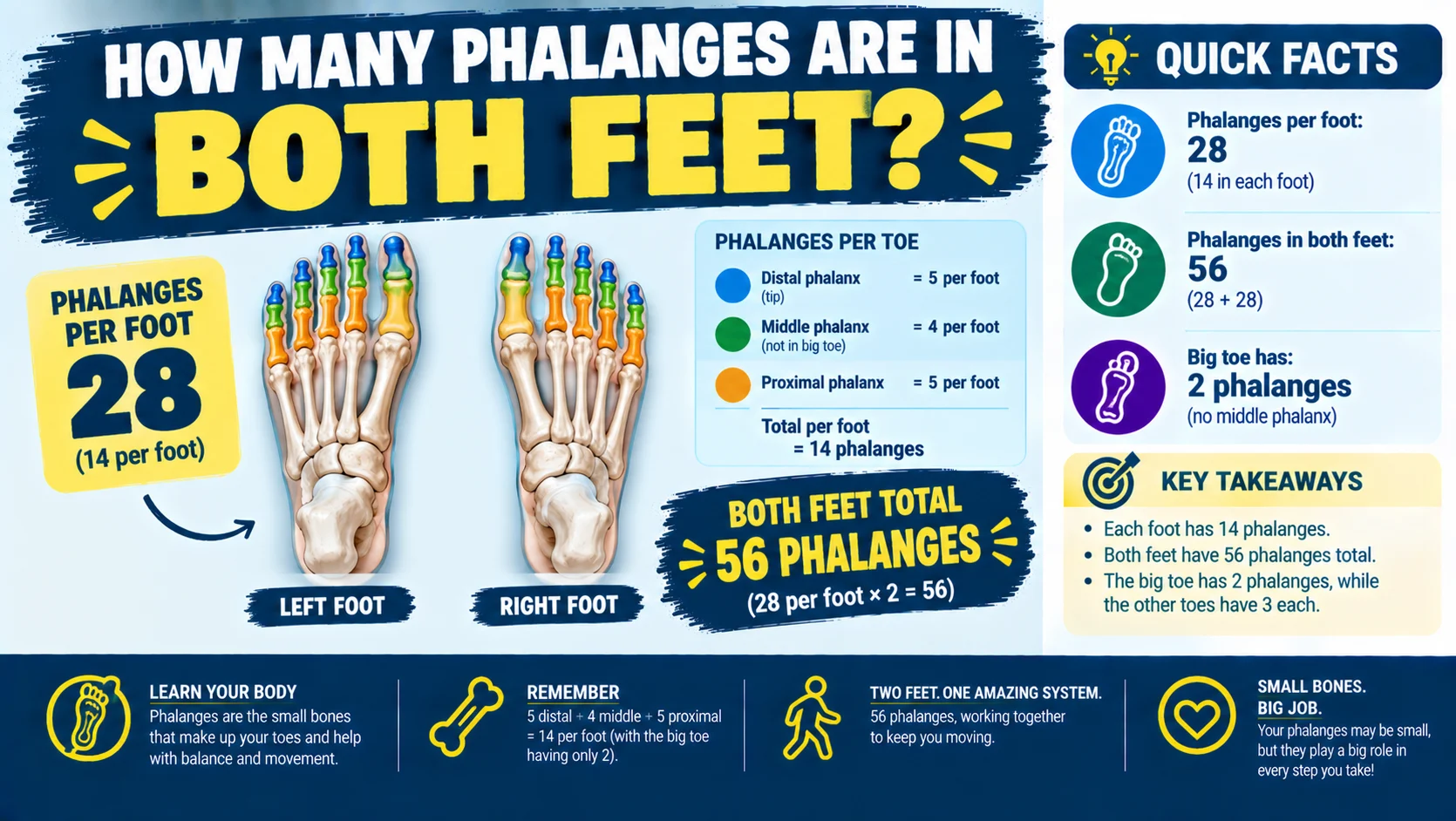
If you’ve ever studied human anatomy or simply wondered about your body’s structure, you may have asked: how many phalanges are in both feet?
The answer is straightforward:
There are 28 phalanges in both human feet combined.
These small bones make up your toes and play a crucial role in balance, walking, running, and stability.
In this guide, you’ll learn exactly how toe bones are structured, how the count is calculated, and why the big toe is slightly different from the others.
Quick Answer
Each human foot contains:
14 phalanges per foot
So in both feet combined:
28 phalanges total
What Are Phalanges?
Phalanges are:
The small bones that make up your fingers and toes.
In the feet, they are called:
- Toe bones
Each toe (except the big toe) has:
- Three phalanges
The big toe has:
- Two phalanges
These bones are essential for:
- Balance
- Movement
- Shock absorption while walking
How Many Phalanges Are in One Foot?
Each foot contains:
14 phalanges in one foot
Breakdown:
- 4 toes × 3 phalanges each = 12
- Big toe × 2 phalanges = 2
Total:
- 12 + 2 = 14 phalanges
How Many Phalanges Are in Both Feet?
Since humans have two feet:
14×2=28 phalanges
Final Answer:
28 phalanges in both feet combined
Breakdown of Toe Bone Structure
Each toe is made up of specific bone segments.
1. Proximal Phalanges
- Closest to the foot
- Found in all toes
2. Middle Phalanges
- Only present in toes 2–5
- Absent in the big toe
3. Distal Phalanges
- Tips of each toe
- Support nails
Toe Bone Distribution Chart
| Toe | Phalanges Count |
|---|---|
| Big toe | 2 |
| Second toe | 3 |
| Third toe | 3 |
| Fourth toe | 3 |
| Fifth toe | 3 |
Total per foot = 14 phalanges
Total Bone Count in the Feet
Beyond phalanges, each foot also contains:
- Metatarsals (5 bones)
- Tarsals (7 bones)
Total foot bones:
26 bones per foot
So both feet together contain:
- 52 total bones
Why the Big Toe Is Different
The big toe (hallux) has:
- Only 2 phalanges instead of 3
This design allows:
- Strong push-off during walking
- Better balance
- Efficient weight distribution
Human Foot Anatomy Overview
The human foot is a complex structure made for:
- Stability
- Movement
- Shock absorption
It includes:
- 26 bones
- 33 joints
- Over 100 muscles, tendons, and ligaments
Phalanges are a key part of this system.
Common Misunderstandings About Toe Bones
“All toes have 3 bones”
Incorrect — the big toe only has 2.
“Feet have fewer bones than hands”
Actually:
- Hands and feet have similar phalange structures
“Phalanges are unimportant”
They are essential for:
- Walking
- Balance
- Running efficiency
Medical Importance of Phalanges
Phalanges are important in:
- Fracture diagnosis
- Arthritis conditions
- Sports injuries
- Foot deformities like hammertoe
Even small injuries can affect mobility significantly.
Why Understanding Phalanges Matters
Knowing how many phalanges are in both feet helps in:
- Anatomy education
- Medical studies
- Physical therapy
- Sports science
- General health awareness
Expert Insight
The structure of 28 phalanges in both feet:
- Optimizes human balance
- Supports upright walking (bipedal motion)
- Helps distribute body weight efficiently
This bone arrangement is a key reason humans can walk long distances efficiently.
FAQs
1. How many phalanges are in both feet?
There are 28 phalanges total.
2. How many phalanges are in one foot?
Each foot has 14 phalanges.
3. Why does the big toe have fewer bones?
It has only 2 phalanges for strength and balance.
4. Are phalanges only in toes?
No, they are also in fingers.
5. How many total bones are in both feet?
There are 52 bones in both feet combined.
Conclusion
So, how many phalanges are in both feet? The human body contains 28 phalanges across both feet, carefully structured to support balance, movement, and stability.
Each foot has 14 phalanges, with a unique design where the big toe contains only two bones while the other toes contain three.
Understanding this anatomy helps you appreciate how efficiently the human foot is built for walking, running, and daily movement.



Pingback: How Many Square Feet Is Nebraska Furniture Mart?