

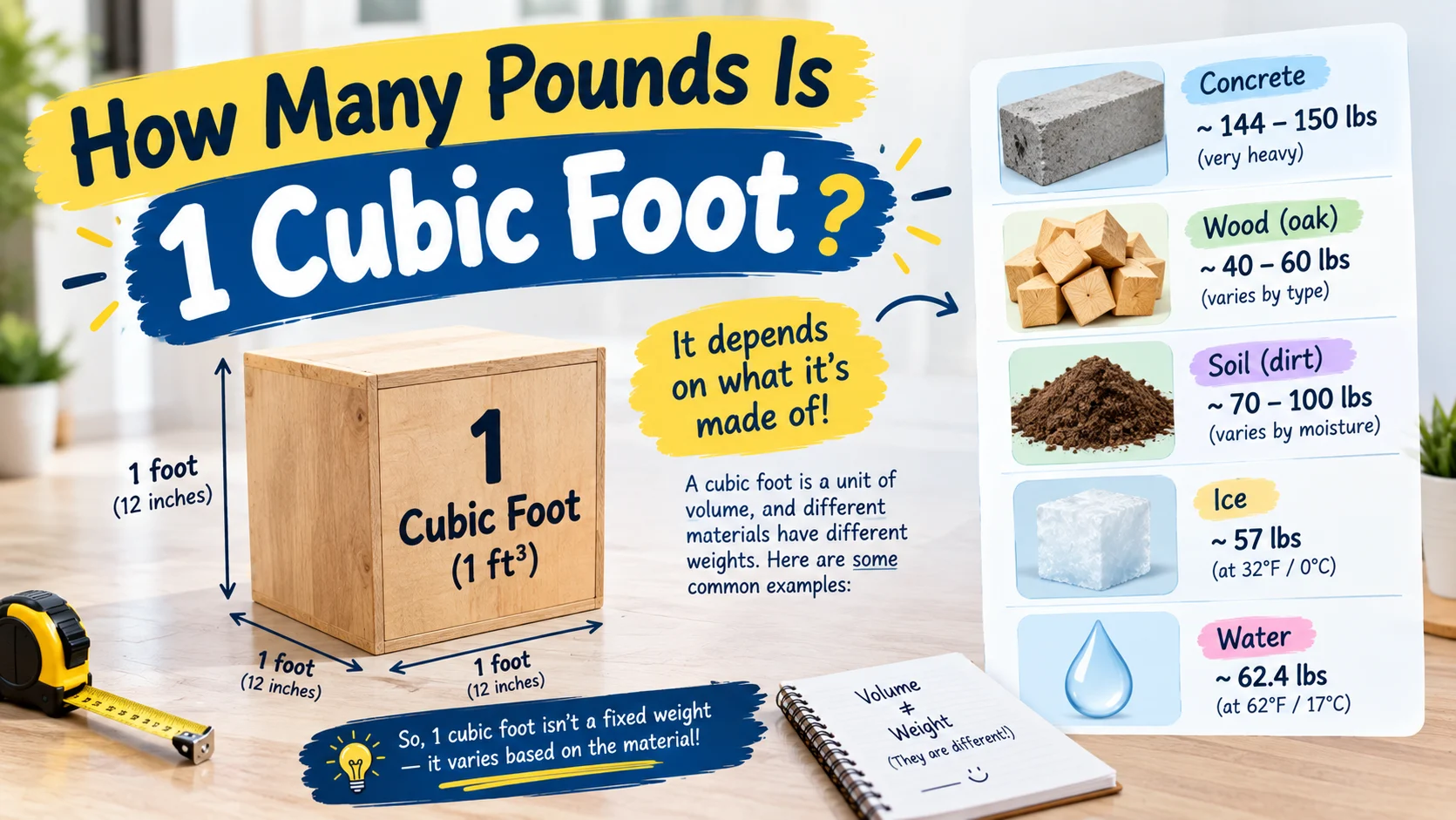
If you’ve ever worked on a construction, landscaping, or moving project, you may have asked: how many pounds is 1 cubic foot?
The answer is:
There is no single fixed weight because it depends on the material being measured.
A cubic foot is a measure of volume, while pounds measure weight. Different materials have different densities, which means their weight per cubic foot varies widely.
For example:
- 1 cubic foot of water weighs about 62.4 pounds
- 1 cubic foot of dry soil can weigh 75–100 pounds
- 1 cubic foot of concrete can weigh over 150 pounds
In this guide, you’ll learn how to convert cubic feet into pounds, plus real-world weight examples for common materials.
Quick Answer
Here are typical weights for 1 cubic foot of common materials:
| Material | Weight (per 1 cubic foot) |
|---|---|
| Water | 62.4 lbs |
| Dry sand | 90–100 lbs |
| Soil (dry) | 75–100 lbs |
| Gravel | 90–120 lbs |
| Concrete | 140–150 lbs |
| Wood (varies) | 20–50 lbs |
Why 1 Cubic Foot Has Different Weights
The weight of 1 cubic foot depends on:
1. Density of Material
Density determines how tightly matter is packed.
2. Moisture Content
Wet materials weigh more than dry ones.
3. Material Type
- Loose materials (mulch) are lighter
- Dense materials (concrete) are heavier
4. Compaction
Packed soil or gravel weighs more per cubic foot.
Formula for Cubic Feet to Pounds Conversion
The general formula is:
Weight (lbs)=Cubic Feet×Density (lbs/ft3)
So:
- You must know the material density
- Then multiply by volume
Water: The Standard Reference
Water is the standard used for many conversions.
Weight of Water per Cubic Foot:
1 cubic foot of water=62.4 pounds
This is used in engineering and physics as a baseline.
Soil, Sand, and Gravel Weights
Dry Soil
- 75–100 lbs per cubic foot
Wet Soil
- Can exceed 100–120 lbs
Sand
90 to 100 pounds per cubic foot
Gravel
- 90–120 lbs per cubic foot depending on size and compaction
These materials are commonly used in:
- Landscaping
- Construction
- Road building
Concrete Weight Per Cubic Foot
Concrete is one of the heaviest common materials:
1 cubic foot of concrete≈150 pounds
This makes it:
- Extremely strong
- But very heavy to transport
Wood and Construction Materials
Wood varies widely depending on type and moisture.
Examples:
- Pine: ~25–35 lbs per cubic foot
- Oak: ~45–60 lbs per cubic foot
Dry wood is lighter than wet wood.
Real-World Examples
Example 1: Moving Dirt
If you have:
- 10 cubic feet of soil
Weight estimate:
10×80=800 pounds (approx)
Example 2: Gravel Delivery
- 5 cubic feet of gravel
5×100=500 pounds (approx)
Example 3: Concrete Slab
- 3 cubic feet of concrete
3×150=450 pounds
Common Mistakes in Weight Conversion
Assuming All Materials Weigh the Same
Every material has different density.
Ignoring Moisture
Wet soil is much heavier.
Confusing Volume and Weight
Cubic feet ≠ pounds directly.
Not Using Correct Density Values
Always verify material type.
Expert Tips for Estimating Weight
Use Standard Density Charts
Helpful for quick estimates.
Add Safety Margin
Include:
- 10–20% extra for moisture or compaction
Break Large Volumes Into Smaller Units
Easier to calculate and manage.
Use Online Calculators for Accuracy
Especially for construction projects.
Why This Conversion Matters
Understanding how many pounds is 1 cubic foot helps with:
- Moving heavy materials safely
- Ordering construction supplies
- Estimating shipping weight
- Planning landscaping projects
- Preventing overloads in vehicles
Accurate weight estimates are critical for safety and budgeting.
FAQs
1. How many pounds is 1 cubic foot?
It depends on the material water is 62.4 lbs, soil and gravel are heavier.
2. What is the heaviest common cubic foot material?
Concrete at about 150 lbs per cubic foot.
3. How much does 1 cubic foot of sand weigh?
About 90–100 pounds.
4. Is wet soil heavier than dry soil?
Yes, significantly heavier due to water content.
5. Can cubic feet directly convert to pounds?
No, you must know the material density.
Conclusion
So, how many pounds is 1 cubic foot? The answer depends entirely on what you’re measuring.
- Water: 62.4 lbs
- Soil: 75–100 lbs
- Gravel: 90–120 lbs
- Concrete: ~150 lbs
Because weight depends on density, there is no single fixed conversion. Understanding this helps you make accurate estimates for construction, landscaping, and transportation projects, ensuring safety and efficiency every time.



Pingback: How Many Phalanges Are in Both Feet?