
Manhattan is one of the most famous urban areas in the world. Known for its skyscrapers, financial districts, luxury real estate, and cultural landmarks, many people wonder:
How many square feet is Manhattan?
The answer depends on whether you are measuring:
- Total borough area
- Land area only
- Including water area
- Individual neighborhoods
- Developable real estate space
However, the commonly accepted land measurement is:
Quick Answer
Manhattan contains approximately:
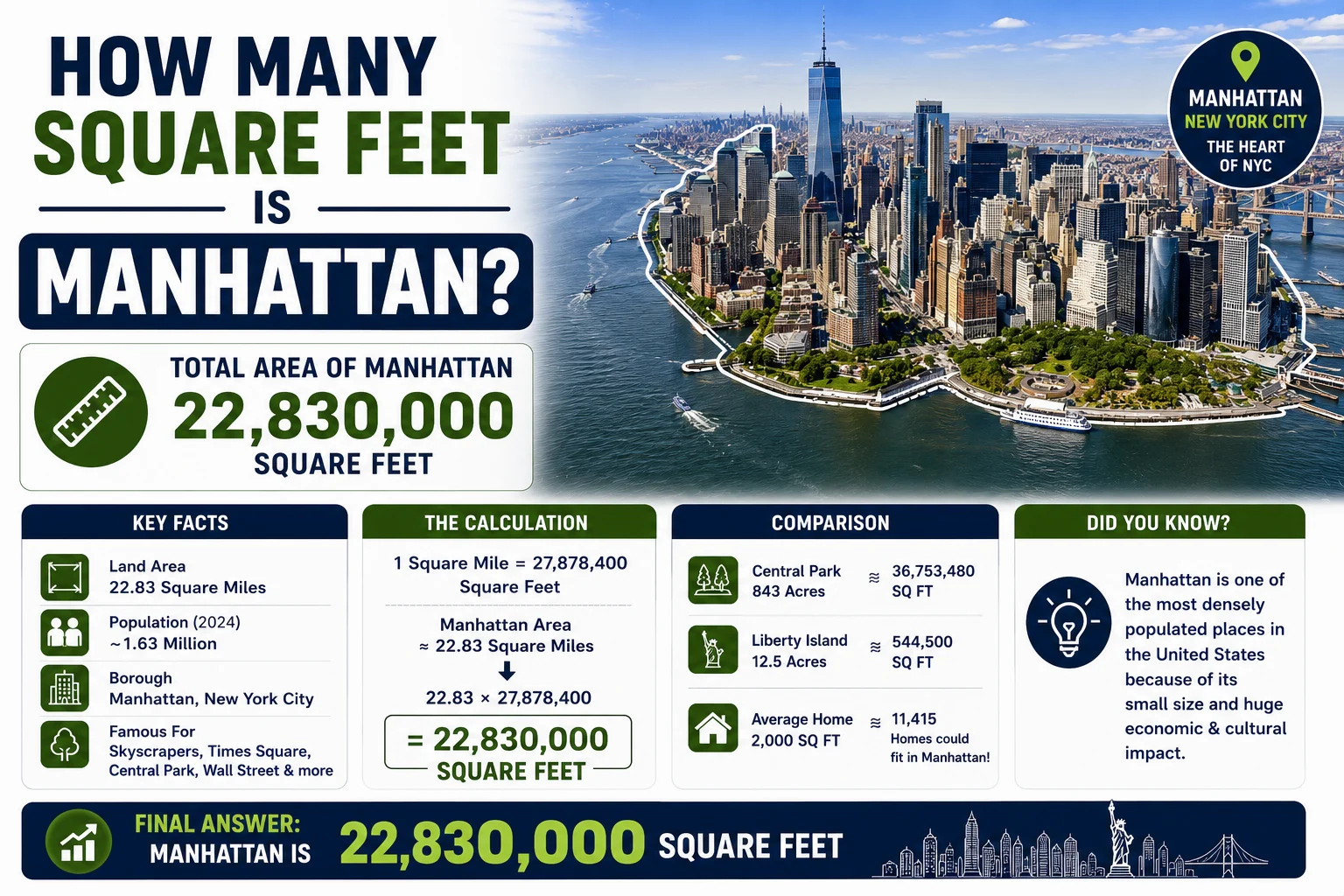
22.83 square miles
Since:
1 square mile=27,878,400 square feet
The calculation becomes:
22.83×27,878,400=636,163,872 square feet
Final Answer
Manhattan contains approximately 636 million square feet of land area.
Including water areas, the total size is even larger.
Understanding Manhattan’s Size
Manhattan is one of the five boroughs of New York City.
It is:
- Extremely dense
- Highly developed
- Financially valuable
- Geographically compact
Despite its global influence, Manhattan is relatively small in physical size compared to many American cities.
Manhattan Total Area Breakdown
Total Area (Including Water)
Manhattan’s total area is approximately:
33.6 square miles
This includes:
- Land
- Rivers
- Waterfront areas
- Small islands
Converted into square feet:
33.6×27,878,400=936,714,240 square feet
Total Area Including Water
Approximately 937 million square feet
Manhattan Land Area Only
Most references use land area instead of total area.
Land area:
22.83 square miles
Converted:
22.83×27,878,400=636,163,872 square feet
Land Area Only
Approximately 636 million square feet
How Big Is Manhattan Compared to Other Places?
Compared to Central Park
Central Park covers about:
843 acres
Since:
1 acre=43,560 square feet
Central Park equals:
843×43,560=36,721,080 square feet
That means Central Park alone occupies more than 36 million square feet.
Compared to a Football Field
One NFL football field including end zones is approximately:
57,600 square feet
Manhattan could fit roughly:
636,163,872÷57,600≈11,044
Result
Manhattan is roughly equal to over 11,000 football fields.
Compared to an Acre
Since one acre equals 43,560 square feet:
636,163,872÷43,560≈14,604 acres
Result
Manhattan covers about 14,600 acres.
Manhattan Population Density
One reason Manhattan feels enormous is population density.
Despite having “only” about 636 million square feet of land, millions of people live and work there.
Estimated population:
- About 1.6 million residents
- Millions more commuters and tourists daily
This creates one of the highest urban population densities in the world.
Why Manhattan Feels Bigger Than It Is
Several factors make Manhattan feel much larger:
1. Vertical Construction
Manhattan builds upward instead of outward.
Skyscrapers dramatically increase usable floor space.
A single office tower may contain:
- Millions of square feet
- Hundreds of businesses
- Thousands of workers
2. Mixed Land Use
Manhattan combines:
- Residential
- Commercial
- Retail
- Entertainment
- Government
- Tourism
All within compact blocks.
3. Transportation Density
Subways, buses, taxis, sidewalks, and rail systems maximize movement in a relatively small area.
Manhattan Neighborhood Sizes
Different Manhattan neighborhoods vary dramatically in size.
Lower Manhattan
Known for:
- Wall Street
- Financial District
- One World Trade Center
Compact but extremely valuable real estate.
Midtown Manhattan
Includes:
- Times Square
- Empire State Building
- Rockefeller Center
Contains some of the world’s densest office development.
Upper Manhattan
Includes:
- Harlem
- Washington Heights
- Inwood
More residential density and larger neighborhood footprints.
Real Estate and Square Foot Value
Manhattan real estate is among the most expensive on Earth.
In some neighborhoods:
- Residential apartments sell for thousands of dollars per square foot
- Office space rents at premium rates
- Retail storefronts command enormous prices
Because land is limited, square footage becomes incredibly valuable.
Buildable Square Footage vs Land Area
An important distinction:
Land Area
Physical footprint of Manhattan.
Buildable Floor Area
Total usable interior building space.
Because of skyscrapers, Manhattan’s usable floor area is many times larger than its land footprint.
For example:
- One skyscraper may contain 2 million square feet
- Entire districts contain hundreds of millions of interior square feet
Manhattan Infrastructure in Square Feet
Manhattan’s land includes:
- Streets
- Parks
- Sidewalks
- Bridges
- Subway systems
- Residential towers
- Commercial districts
A surprisingly large portion is dedicated to transportation and public infrastructure.
Historical Growth of Manhattan
Originally, Manhattan was much smaller in developed area.
Over centuries:
- Shorelines expanded through landfill
- Streets were reorganized
- Buildings became taller
- Density increased dramatically
Modern Manhattan represents one of the most intense urban developments in history.
Manhattan Compared to Other Cities
Manhattan vs Los Angeles
Los Angeles is geographically much larger.
However:
- Manhattan is denser
- Manhattan has more vertical construction
- Manhattan contains more concentrated economic activity
Manhattan vs Paris
Paris and Manhattan share similarities:
- Dense urban planning
- High tourism
- Expensive real estate
But Manhattan generally has taller buildings.
Manhattan vs London
London is geographically larger, but Manhattan remains one of the world’s most concentrated financial centers.
Interesting Manhattan Size Facts
Fact 1
Manhattan is only about:
13.4 miles long
Fact 2
At its widest point, Manhattan is roughly:
2.3 miles wide
Fact 3
Millions of people move through Manhattan daily despite its relatively compact land size.
Fact 4
Some Manhattan skyscrapers individually contain over 1 million square feet.
Common Misconceptions
Manhattan Is Huge
In global influence? Yes.
In land area? Actually fairly compact.
All Square Footage Is Usable
A large percentage is:
- Roads
- Public space
- Infrastructure
- Utilities
Skyscrapers Increase Land Area
Tall buildings increase usable floor space, not physical land size.
Why Understanding Manhattan’s Size Matters
Knowing Manhattan’s square footage helps with:
- Real estate analysis
- Urban planning
- Infrastructure studies
- Tourism understanding
- Population density analysis
- Commercial property evaluation
It also helps explain why Manhattan real estate is so valuable.
Frequently Asked Questions
How many square feet is Manhattan?
Approximately:
636 million square feet of land area
How many acres is Manhattan?
About:
14,600 acres
How many square miles is Manhattan?
About:
22.83 square miles of land area
Is Manhattan larger than Central Park?
Yes.
Central Park is about 843 acres, while Manhattan is over 14,000 acres.
Why is Manhattan so expensive?
Because:
- Land is limited
- Demand is extremely high
- Economic activity is concentrated
- Buildable space is valuable
Conclusion
So, how many square feet is Manhattan?
The widely accepted land-area answer is:
636,163,872 square feet
That equals:
- About 636 million square feet
- Around 14,600 acres
- Roughly 22.83 square miles
Although Manhattan is geographically compact, its vertical development, massive population density, and economic importance make it one of the most influential urban areas in the world.
From towering skyscrapers to world-famous neighborhoods, Manhattan demonstrates how a relatively small amount of land can support extraordinary levels of human activity, commerce, culture, and infrastructure.