

When choosing a heating or cooling system, one of the most important questions homeowners ask is:
How many BTUs per square foot do I need?
BTU requirements determine whether your HVAC system can efficiently heat or cool a room, apartment, or entire house. Choosing the wrong size can lead to:
- Higher energy bills
- Uneven temperatures
- Poor comfort
- Excess wear on equipment
Understanding BTUs per square foot helps you estimate the right system size for your home or office.
What Does BTU Mean?
BTU stands for:
BTU=British Thermal Unit
A BTU measures:
The amount of energy required to raise one pound of water by 1°F.
In HVAC systems:
- Higher BTUs = more heating or cooling power
- Lower BTUs = smaller capacity
Quick Answer
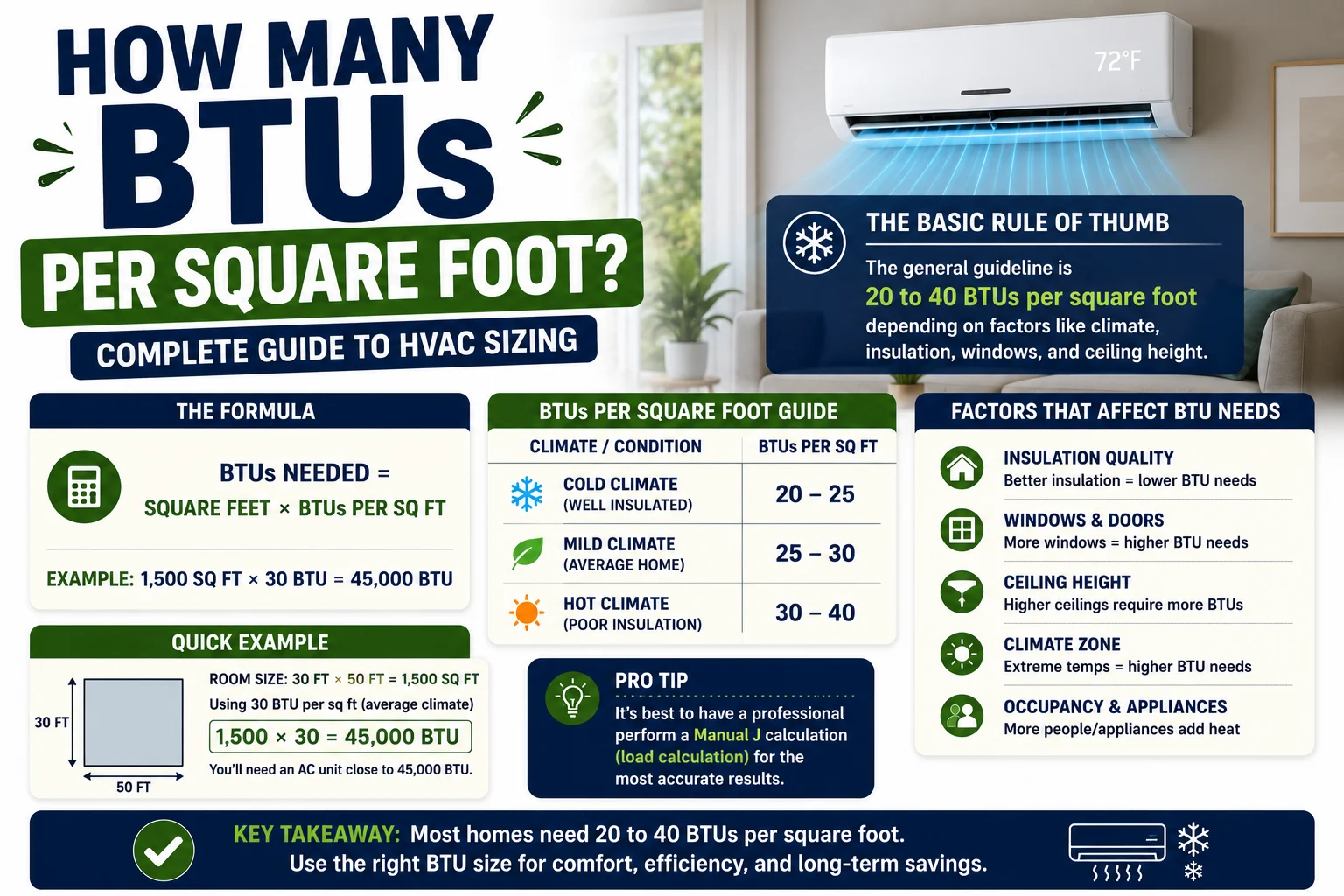
For most homes, the general guideline is:
20 to 30 BTUs per square foot
Final Answer:
Most homes require approximately 20–30 BTUs per square foot for heating or cooling.
However, the exact number depends on:
- Climate
- Ceiling height
- Insulation
- Sun exposure
- Number of occupants
Basic BTU Per Square Foot Formula
The standard HVAC sizing formula is:
Room Size×BTUs per Sq Ft
Example for a 500-square-foot room using 25 BTUs:
500×25=12,500 BTUs
Result:
A 500 sq ft room may need about 12,500 BTUs.
Standard BTU Recommendations by Room Size
| Room Size | Recommended BTUs |
|---|---|
| 100 sq ft | 2,000–3,000 BTUs |
| 200 sq ft | 4,000–6,000 BTUs |
| 300 sq ft | 6,000–9,000 BTUs |
| 500 sq ft | 10,000–15,000 BTUs |
| 1,000 sq ft | 20,000–30,000 BTUs |
| 2,000 sq ft | 40,000–60,000 BTUs |
These estimates are general guidelines for residential spaces.
BTUs for Air Conditioning
Cooling systems often follow these averages:
Moderate Climate
Most homes use:
20 BTUs per square foot
Hot Climate
Warmer areas may require:
25 to 30 BTUs per square foot
Example Calculation
For a 1,200 sq ft home in a warm climate:
1,200×25=30,000 BTUs
BTUs for Heating
Heating calculations vary more because winter temperatures differ widely.
Cold climates generally require:
- More BTUs
- Larger furnaces
- Better insulation
Typical Heating Requirements
| Climate | BTUs Per Sq Ft |
|---|---|
| Warm climate | 20–30 |
| Moderate climate | 30–40 |
| Cold climate | 40–60 |
Why Climate Matters
Climate significantly impacts HVAC sizing.
Hot Regions
Air conditioners work harder due to:
- High outdoor temperatures
- Humidity
- Solar heat gain
Cold Regions
Heating systems require:
- Higher furnace output
- Longer run times
- More energy
Ceiling Height and BTUs
Most calculations assume:
- 8-foot ceilings
If ceilings are higher:
- Additional BTUs are needed
Example:
A room with 12-foot ceilings contains more air volume than the same square footage with standard ceilings.
Insulation Effects
Good insulation reduces BTU requirements.
Well-Insulated Homes
Need:
- Smaller HVAC systems
- Less energy
Poorly Insulated Homes
Need:
- More BTUs
- Longer heating/cooling cycles
Insulation quality includes:
- Wall insulation
- Attic insulation
- Window efficiency
- Air sealing
Sunlight and Window Exposure
Large windows increase heat gain.
South-facing rooms often require:
- Additional cooling BTUs
Rooms with:
- Skylights
- Glass walls
- Direct afternoon sun
Usually need larger HVAC capacity.
Occupancy and Appliances
People and electronics generate heat.
Extra BTUs may be needed for:
- Kitchens
- Home gyms
- Offices with electronics
- Crowded rooms
HVAC Tons vs BTUs
Air conditioning systems are often measured in tons.
Conversion:
1 ton=12,000 BTUs
Examples
| AC Size | BTUs |
|---|---|
| 1 ton | 12,000 BTUs |
| 2 ton | 24,000 BTUs |
| 3 ton | 36,000 BTUs |
| 4 ton | 48,000 BTUs |
Example Home Calculations
Small Bedroom
Room size:
10×12=120 sq ft
BTU estimate:
120×20=2,400 BTUs
Living Room
Room size:
20×18=360 sq ft
Cooling estimate:
360×25=9,000 BTUs
Entire Home
2,000-square-foot house:
2,000×25=50,000 BTUs
Equivalent AC size:
50,000÷12,000≈4.2 tons
Oversized vs Undersized HVAC Systems
Choosing incorrect BTUs can create problems.
Oversized System
May cause:
- Short cycling
- Higher humidity
- Energy waste
- Uneven temperatures
Undersized System
May result in:
- Constant running
- Poor comfort
- Inadequate cooling/heating
- Faster wear
Proper sizing is essential.
Mini Split BTU Sizing
Mini split systems use the same principles.
Typical recommendations:
| Room Size | Mini Split Size |
|---|---|
| 150–250 sq ft | 6,000 BTUs |
| 250–400 sq ft | 9,000 BTUs |
| 400–600 sq ft | 12,000 BTUs |
| 600–1,000 sq ft | 18,000 BTUs |
Commercial Spaces
Commercial buildings often require different calculations because of:
- Occupancy
- Equipment heat
- Lighting
- Ventilation needs
Professional HVAC load calculations are usually necessary.
Energy Efficiency Considerations
High-efficiency HVAC systems may:
- Reduce operating costs
- Maintain comfort better
- Require smaller effective loads
SEER ratings and furnace AFUE ratings influence efficiency.
Common BTU Calculation Mistakes
❌ Using square footage alone
Other factors matter greatly.
❌ Ignoring climate
Hot and cold regions differ dramatically.
❌ Forgetting insulation quality
Poor insulation increases demand.
❌ Buying the largest unit possible
Oversized systems can perform worse.
Professional HVAC Load Calculations
HVAC professionals use:
- Manual J calculations
- Home orientation
- Air leakage measurements
- Occupancy estimates
These provide more accurate sizing than simple BTU-per-square-foot estimates.
Why Proper BTU Sizing Matters
Correct BTU sizing helps:
- Improve comfort
- Reduce energy bills
- Extend HVAC lifespan
- Improve indoor air quality
- Maintain stable temperatures
A properly sized system operates:
- More efficiently
- More quietly
- More consistently
FAQs
How many BTUs per square foot do I need?
Most homes need:
20–30 BTUs per square foot
How many BTUs for 1,000 square feet?
Typically:
20,000–30,000 BTUs
How many BTUs for 2,000 square feet?
Usually:
40,000–60,000 BTUs
What size AC unit do I need?
Depends on:
- Square footage
- Climate
- Insulation
- Ceiling height
Is higher BTU always better?
No. Oversized systems may reduce efficiency and comfort.
Conclusion
So, how many BTUs per square foot do you need?
The general answer is:
Most homes require between 20 and 30 BTUs per square foot.
However, the ideal HVAC size depends on many factors including climate, insulation, sunlight exposure, and ceiling height. Understanding BTU requirements helps homeowners choose the right heating and cooling system for maximum efficiency, comfort, and long-term performance.