
If you are planning a painting, staining, sealing, or coating project, one of the most important questions is:
“How many square feet does a gallon cover?”
Understanding paint or coating coverage helps you:
- Estimate material costs
- Avoid buying too much paint
- Prevent running out mid-project
- Plan labor and project timelines accurately
In most situations:
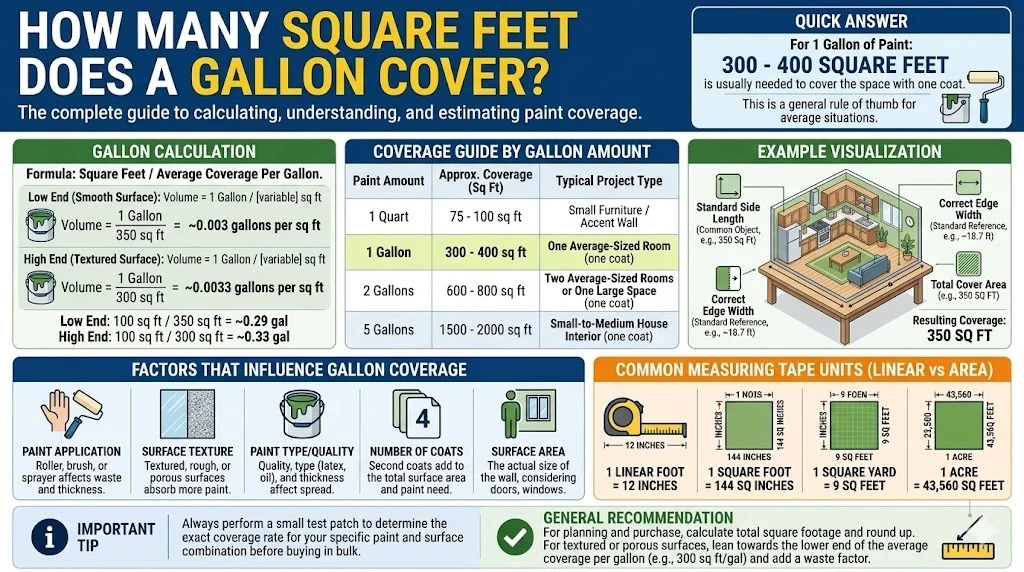
One gallon of paint covers approximately 350 to 400 square feet with one coat.
However, actual coverage depends on several factors including:
- Surface texture
- Paint type
- Application method
- Number of coats
- Porosity of the material
- Primer usage
In this complete guide, you will learn:
- How many square feet a gallon typically covers
- Coverage formulas
- Interior and exterior paint estimates
- Different coating coverage rates
- Real-world examples
- Common mistakes to avoid
- Professional painting tips
- Frequently asked questions
Let’s begin.
Quick Answer: How Many Square Feet Does a Gallon Cover?
The standard estimate is:
1 gallon≈350–400 square feet
This estimate assumes:
- Smooth surfaces
- One coat
- Standard paint application
- Proper preparation
Most paint manufacturers use:
- 350–400 sq ft per gallon
As a guideline.
Average Paint Coverage by Type
Different products cover different amounts of area.
| Product Type | Approximate Coverage |
|---|---|
| Interior paint | 350–400 sq ft |
| Exterior paint | 250–400 sq ft |
| Primer | 200–300 sq ft |
| Deck stain | 150–300 sq ft |
| Concrete sealer | 150–300 sq ft |
| Epoxy coating | 150–250 sq ft |
Paint Coverage Formula
The basic formula is:
Gallons Needed=Coverage Per GallonTotal Square Feet
Example Calculation
Suppose a room has:
- 800 square feet of wall area
Paint coverage:
- 400 sq ft per gallon
Calculation:
800÷400=2 gallons
Result:
You need approximately 2 gallons for one coat.
Why Coverage Varies
Not every project gets the same coverage.
Several important factors affect paint spread.
1. Surface Texture
Smooth surfaces require less paint.
Smooth Surfaces
Examples:
- Drywall
- Finished wood
- Metal
Coverage:
- Closer to 400 sq ft per gallon
Rough Surfaces
Examples:
- Stucco
- Brick
- Concrete block
Coverage:
- Often closer to 250–300 sq ft
Rough materials absorb more paint.
2. Number of Coats
Most projects require:
- Two coats
Example:
If one gallon covers:
- 400 sq ft
Then two coats cover:
- Only 200 sq ft effectively
3. Paint Quality
Higher-quality paints often:
- Cover better
- Require fewer coats
- Spread more evenly
Cheap paint may require:
- Additional coats
4. Color Changes
Switching between dramatically different colors may require:
- Extra paint
- Additional coats
- Primer
Example:
- Dark wall to white paint
5. Primer Usage
Primer improves paint adhesion and consistency.
Using primer often:
- Reduces overall paint consumption
Especially on:
- Bare drywall
- New wood
- Patched surfaces
6. Application Method
Coverage changes depending on:
- Brush
- Roller
- Paint sprayer
Brush Application
Usually:
- Slower
- Thicker coating
May use more paint.
Roller Application
Most common for walls.
Provides:
- Even coverage
- Efficient application
Sprayer Application
Fastest method.
However:
- Overspray can increase paint usage.
Interior Paint Coverage
Interior wall paint usually covers:
350–400 square feet per gallon
Examples:
- Bedrooms
- Living rooms
- Hallways
- Ceilings
Exterior Paint Coverage
Exterior surfaces often require more paint because they are rougher.
Typical coverage:
- 250–350 sq ft per gallon
Exterior surfaces include:
- Siding
- Brick
- Stucco
- Fences
Ceiling Paint Coverage
Ceilings usually absorb less paint than walls.
Average coverage:
- Around 350–400 sq ft per gallon
However:
- Textured ceilings require more paint.
Primer Coverage
Primer coverage is usually lower.
Typical coverage:
- 200–300 sq ft per gallon
Primer seals porous surfaces.
Deck Stain Coverage
Wood decks absorb stain differently depending on age and condition.
Typical coverage:
- 150–300 sq ft per gallon
Older wood absorbs more product.
Concrete Sealer Coverage
Concrete sealers vary significantly.
Coverage:
- 150–300 sq ft per gallon
Depends on:
- Concrete porosity
- Surface roughness
Real-World Painting Examples
Bedroom Walls
Room dimensions:
- 10 ft × 12 ft
- 8 ft ceilings
Approximate wall area:
- Around 350 sq ft
One gallon may cover:
- The entire room with one coat
Living Room
Wall area:
- 800 sq ft
Coverage:
- 400 sq ft per gallon
Calculation:
800÷400=2
Result:
- 2 gallons per coat
Exterior House
Paintable area:
- 2,000 sq ft
Coverage:
- 300 sq ft per gallon
Calculation:
2000÷300≈6.67
Result:
- About 7 gallons per coat
How to Measure Square Footage for Painting
Measure Wall Length
Example:
- 12 feet
Measure Wall Height
Example:
- 8 feet
Multiply
12×8=96 square feet
Repeat for all walls.
Should You Subtract Doors and Windows?
Professionals sometimes subtract:
- Large windows
- Doors
However, many painters do not subtract smaller openings because:
- Waste
- Touch-ups
- Extra coats
Often balance the difference.
Common Painting Mistakes
Buying Too Little Paint
Running out mid-project can create:
- Color inconsistency
- Sheen differences
Ignoring Second Coats
Most quality jobs require:
- Two coats
Forgetting Surface Texture
Rough surfaces dramatically increase paint usage.
Skipping Primer
Primer often improves coverage significantly.
Professional Painter Tips
Buy Slightly Extra Paint
Extra paint helps with:
- Touch-ups
- Future repairs
Mix Multiple Cans Together
This prevents slight color variation.
Use High-Quality Rollers
Good tools improve:
- Coverage
- Finish quality
Follow Manufacturer Instructions
Different paints have different coverage recommendations.
Paint Coverage Chart
| Surface Area | Paint Needed |
|---|---|
| 200 sq ft | 0.5 gallon |
| 400 sq ft | 1 gallon |
| 800 sq ft | 2 gallons |
| 1,200 sq ft | 3 gallons |
| 2,000 sq ft | 5 gallons |
Approximate estimates for one coat.
FAQs
How many square feet does 1 gallon of paint cover?
Usually:
- 350–400 square feet
Does one gallon cover two coats?
Not usually.
One gallon typically covers:
- 350–400 sq ft for one coat only
How much paint do I need for a 12×12 room?
Usually:
- 1–2 gallons depending on wall height and number of coats
Does textured wall use more paint?
Yes.
Rough surfaces absorb more paint.
How many gallons for 1,000 square feet?
Approximately:
- 2.5–3 gallons per coat
Can paint coverage vary by brand?
Yes.
Different paint formulas cover differently.
Final Thoughts
So, how many square feet does a gallon cover?
A gallon of paint typically covers about 350–400 square feet with one coat under normal conditions.
However, actual coverage depends on:
- Surface texture
- Paint quality
- Application method
- Number of coats
- Primer usage
- Surface condition
Understanding paint coverage helps you:
- Estimate costs accurately
- Avoid wasted material
- Improve project planning
- Achieve professional-looking results
Whether you are painting walls, ceilings, decks, fences, or exterior siding, knowing how much area a gallon covers helps your project go more smoothly and efficiently.