

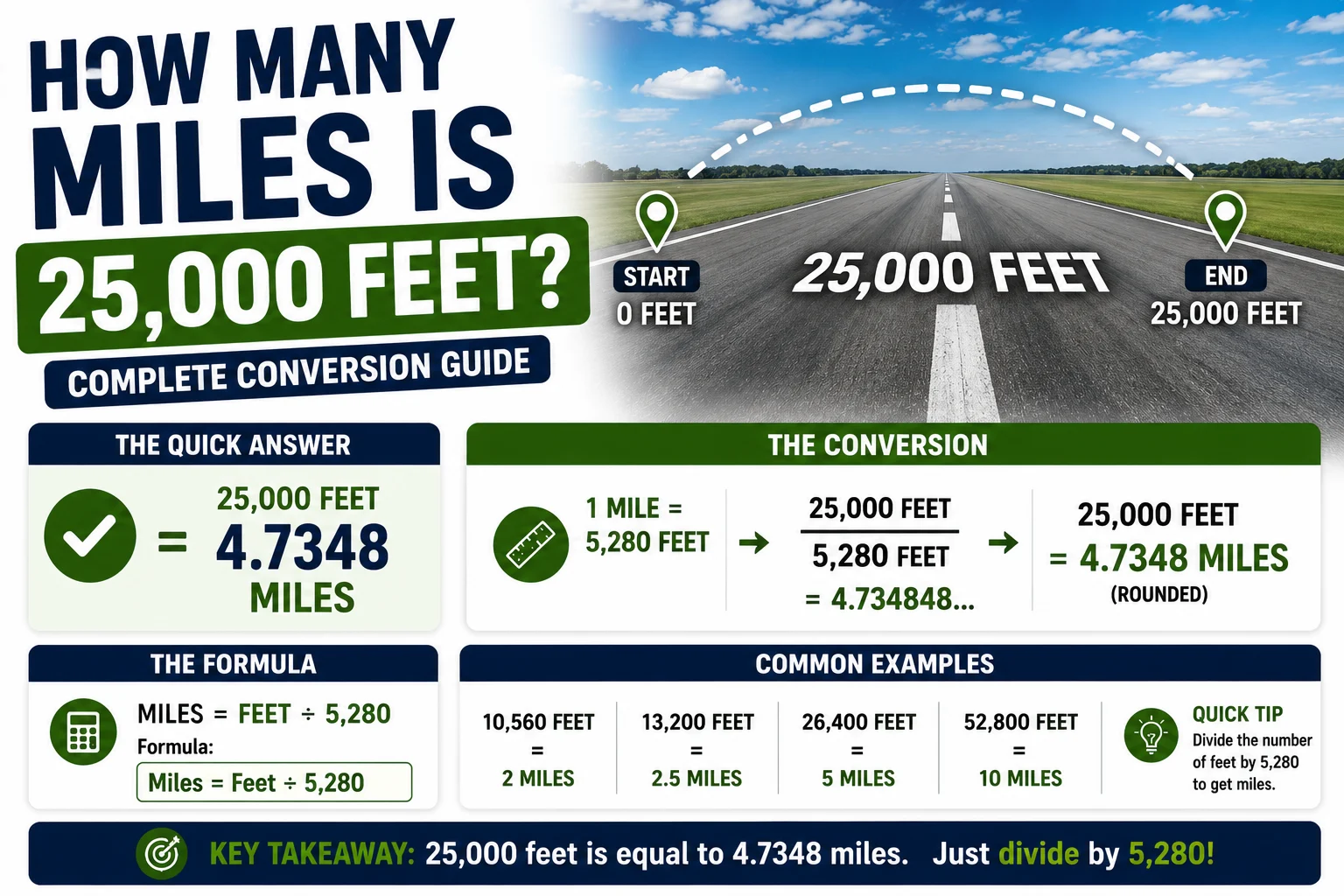
Converting feet into miles is a common calculation used in aviation, hiking, construction, geography, and education. One frequently asked question is:
How many miles is 25,000 feet?
Whether you’re discussing airplane altitude, mountain elevation, or long-distance measurements, understanding how feet convert into miles helps provide better perspective on distance and scale.
The conversion is straightforward once you know the standard relationship between feet and miles.
Quick Answer
The standard conversion is:
1 mile=5,280 feet
Now divide 25,000 feet by 5,280:
25,000÷5,280≈4.73 miles
Final Answer:
25,000 feet equals approximately 4.73 miles.
Understanding Feet and Miles
Before converting measurements, it helps to understand the units involved.
What Is a Foot?
A foot is a unit of length commonly used in:
- The United States
- Construction
- Aviation
- Sports fields
- Real estate
One foot equals:
- 12 inches
What Is a Mile?
A mile is a larger unit of distance primarily used in:
- Road travel
- Geography
- Running races
- Aviation distances
One mile equals:
5,280 feet
This standard has been used for centuries in the imperial measurement system.
Step-by-Step Conversion
To convert feet into miles:
Formula
Miles=5,280Feet
Insert the value:
5,28025,000≈4.73
Result
25,000 feet is approximately 4.73 miles.
Why 25,000 Feet Is Important
The number 25,000 feet appears frequently in real-world situations.
Aviation
Commercial airplanes commonly fly between:
- 25,000 and 40,000 feet
At 25,000 feet:
- Aircraft are above most weather systems
- Air resistance is reduced
- Fuel efficiency improves
Mountains and Elevation
Some mountain peaks and high-altitude regions approach or exceed 25,000 feet.
Examples include sections of the:
- Himalayas
- Mount Everest region
Skydiving and Military Operations
Extreme skydives and military HALO jumps can occur around:
- 25,000 feet or higher
At these altitudes:
- Oxygen systems are often required
- Temperatures are extremely cold
Visualizing 4.73 Miles
It can be difficult to imagine 25,000 feet, so converting it into miles provides perspective.
Road Distance
4.73 miles is roughly:
- A 10-minute drive in city traffic
- A moderate jogging route
- About 95 football fields end-to-end
Walking Distance
Average walking speed:
3 miles per hour
Walking 4.73 miles would take approximately:
4.73÷3≈1.58 hours
So:
Around 1 hour and 35 minutes
Feet to Miles Conversion Chart
| Feet | Miles |
|---|---|
| 1,000 ft | 0.19 mi |
| 5,280 ft | 1 mi |
| 10,000 ft | 1.89 mi |
| 20,000 ft | 3.79 mi |
| 25,000 ft | 4.73 mi |
| 30,000 ft | 5.68 mi |
| 40,000 ft | 7.58 mi |
Why Converting Feet to Miles Matters
Converting feet into miles helps simplify large measurements.
Easier Visualization
People understand miles more intuitively than thousands of feet.
Useful in Aviation
Pilots regularly work with:
- Altitude in feet
- Distance in miles
Helpful for Hiking and Geography
Mountain elevations and trail distances become easier to compare.
Construction and Engineering
Large infrastructure projects may involve:
- Elevation changes
- Vertical measurements
- Surveying calculations
Common Real-World Examples
Commercial Airplanes
A plane flying at:
- 25,000 feet
Is flying:
Nearly 5 miles above the ground
High Mountains
Some major peaks exceed:
- 25,000 feet in elevation
This is why climbers experience:
- Low oxygen levels
- Extreme cold
- Reduced air pressure
Weather Systems
Thunderstorms can rise above:
- 25,000 feet
Large storm systems may extend even higher.
Understanding Altitude in Aviation
Altitude is typically measured in feet rather than miles.
For example:
- Small aircraft: 5,000–10,000 feet
- Commercial jets: 30,000–40,000 feet
- Military aircraft: higher altitudes possible
At 25,000 feet:
- Cabin pressurization becomes important
- Oxygen levels are significantly lower
Difference Between Vertical and Horizontal Distance
One important distinction:
Vertical Distance
25,000 feet usually refers to:
- Height above ground level
Horizontal Distance
Miles often describe:
- Travel distance along the ground
Even though both use measurement units, they describe different directions.
Common Mistakes in Conversion
❌ Forgetting the exact conversion factor
A mile is:
- 5,280 feet
- Not 5,000 feet
❌ Rounding too early
Rounding before finishing calculations can reduce accuracy.
❌ Mixing metric and imperial units
Feet and miles belong to the imperial system.
Metric Comparison
To convert 25,000 feet into kilometers:
First convert to miles:
4.73 miles
Then convert miles to kilometers:
4.73×1.609≈7.61 km
Result:
25,000 feet ≈ 7.61 kilometers
How Altitude Affects Humans
At 25,000 feet:
- Oxygen levels are much lower
- Humans cannot survive long without supplemental oxygen
- Temperatures may drop below -30°F
This is why:
- Aircraft cabins are pressurized
- Pilots use oxygen systems in some aircraft
Historical Context of the Mile
The modern mile evolved from ancient Roman measurements.
The standardized mile of:
- 5,280 feet
Was officially adopted in England centuries ago and remains widely used today in:
- The United States
- Aviation
- Road systems
Practical Applications of This Conversion
Understanding how many miles 25,000 feet equals can help with:
- Flight tracking
- Hiking elevation understanding
- Engineering calculations
- Education and math problems
- Geography comparisons
FAQs
How many miles is 25,000 feet exactly?
Approximately:
4.73 miles
How do you convert feet into miles?
Use the formula:
Miles=5,280Feet
Is 25,000 feet a high altitude?
Yes, it is considered very high altitude.
How high do commercial airplanes fly?
Typically between:
- 30,000 and 40,000 feet
How many kilometers is 25,000 feet?
Approximately:
7.61 kilometers
Conclusion
So, how many miles is 25,000 feet?
The answer is:
25,000 feet equals approximately 4.73 miles.
This conversion is useful in aviation, geography, hiking, education, and engineering. By understanding the relationship between feet and miles, large distances and altitudes become much easier to visualize and compare in everyday life.