
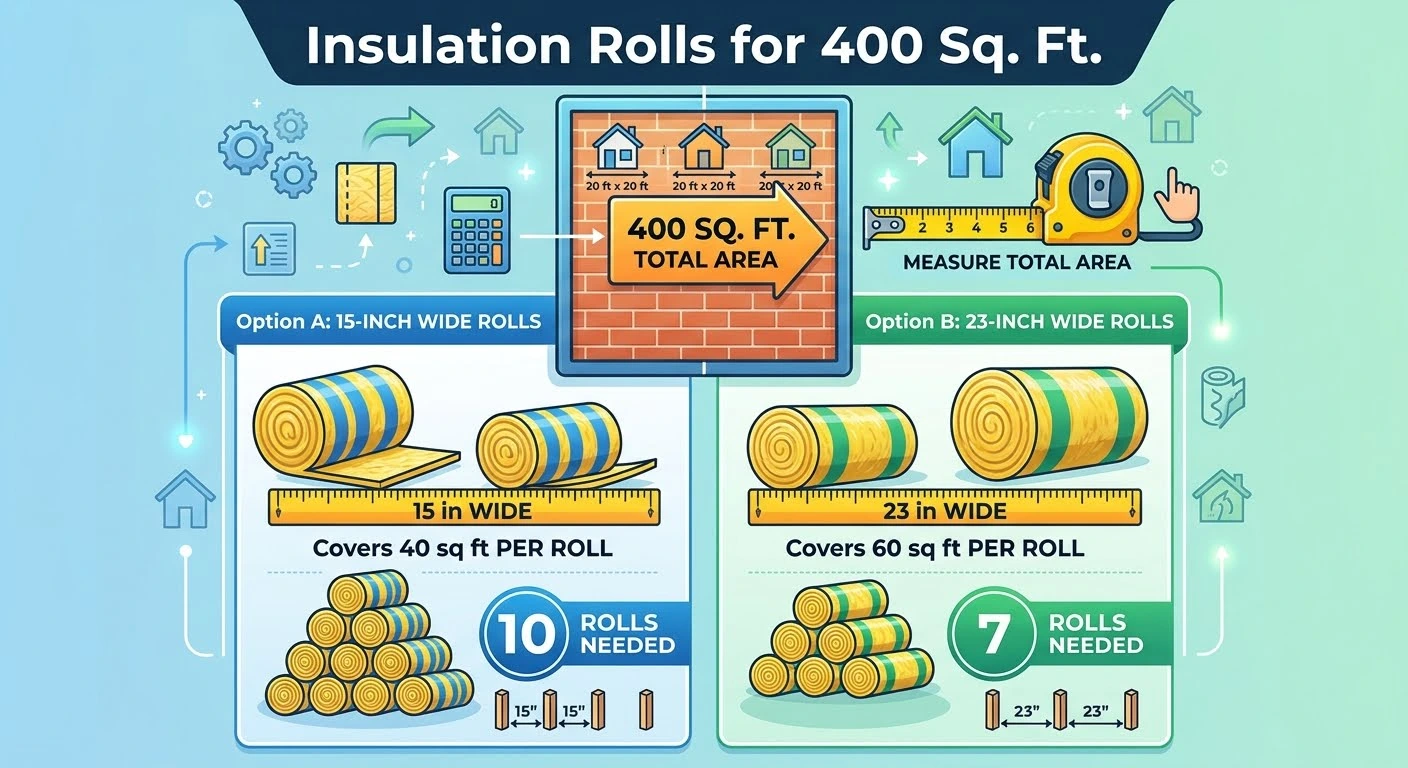
If you’re insulating a room, attic, garage, or crawl space, one of the first questions you’ll ask is: how many rolls of insulation for 400 square feet?
The short answer is:
Most 400-square-foot projects require between 4 and 10 rolls of insulation.
The exact number depends on how much area each roll covers. Some insulation rolls cover about 40 square feet, while others cover 100 square feet or more.
For example:
- If one roll covers 100 square feet, you’ll need 4 rolls.
- If one roll covers 75 square feet, you’ll need 6 rolls.
- If one roll covers 50 square feet, you’ll need 8 rolls.
- If one roll covers 40 square feet, you’ll need 10 rolls.
Because insulation products vary by thickness, width, and R-value, checking the coverage listed on the package is the best way to get an accurate estimate.
In this complete guide, you’ll learn exactly how to calculate insulation needs for 400 square feet, compare common roll sizes, and avoid overbuying or running short during your project.
Quick Answer
The fastest answer to how many rolls of insulation for 400 square feet is:
400 ÷ coverage per roll = number of rolls needed.
Using the formula:
400 ÷ 100 = 4 rolls
400 ÷ 75 ≈ 5.3 rolls (round up to 6)
400 ÷ 50 = 8 rolls
Always round up to the next full roll because insulation is sold in complete packages.
Typical Estimate
For most residential fiberglass insulation products, homeowners generally need:
4 to 8 rolls for 400 square feet.
This range covers the most common insulation products used in attics, floors, and walls.
How Insulation Roll Coverage Works
Not all insulation rolls are the same size.
Each package includes a label showing:
- Total square feet covered
- R-value (thermal resistance)
- Roll dimensions
- Number of pieces or rolls
- Recommended application
What Is R-Value?
R-value measures how well insulation resists heat flow.
Higher R-values provide better insulation but usually result in thicker materials and sometimes less coverage per package.
Common residential R-values include:
- R-13 and R-15 for walls
- R-19 and R-21 for floors
- R-30 to R-49 for attics
Why Coverage Varies
Coverage depends on:
- Roll width (15 inches, 23 inches, etc.)
- Thickness
- Length of material in each roll
- Intended stud spacing (16-inch or 24-inch centers)
Two products with the same R-value may still cover different areas.
How Many Rolls of Insulation for 400 Square Feet?
To determine exactly how many rolls you need, divide the total area by the coverage listed on one roll.
Formula
Number of Rolls = Total Square Feet ÷ Coverage per Roll
Example Calculations
Roll Covers 100 Square Feet
400 ÷ 100 = 4 rolls
Roll Covers 80 Square Feet
400 ÷ 80 = 5 rolls
Roll Covers 60 Square Feet
400 ÷ 60 = 6.67 rolls → round up to 7 rolls
Roll Covers 50 Square Feet
400 ÷ 50 = 8 rolls
Best Practice
Always purchase one extra roll if:
- You are a first-time DIY installer
- The space has many corners or obstacles
- You expect cutting waste
- You want a safety margin
Insulation Coverage Chart
| Coverage Per Roll | Rolls Needed for 400 Sq Ft |
|---|---|
| 120 sq ft | 4 rolls |
| 100 sq ft | 4 rolls |
| 80 sq ft | 5 rolls |
| 75 sq ft | 6 rolls |
| 60 sq ft | 7 rolls |
| 50 sq ft | 8 rolls |
| 40 sq ft | 10 rolls |
This chart makes it easy to estimate insulation quantities without doing the math every time.
Common Roll Coverage by Application
Different parts of the home often use different insulation products.
Wall Insulation
Wall insulation rolls typically cover:
- 40 to 70 square feet per roll
For 400 square feet, you may need:
6 to 10 rolls.
Attic Insulation
Attic insulation rolls often cover:
- 60 to 120 square feet per roll
For 400 square feet, you may need:
4 to 7 rolls.
Floor or Crawl Space Insulation
These products generally cover:
- 50 to 100 square feet per roll
For 400 square feet, you may need:
4 to 8 rolls.
Factors That Affect How Many Rolls You Need
Several real-world conditions can change your estimate.
1. Waste Allowance
Cuts around outlets, ducts, and framing create waste.
Recommended extra material:
- 5% for simple layouts
- 10% for complex spaces
For a 400-square-foot project, a 10% waste allowance means planning for:
440 square feet of coverage.
2. Stud Spacing
Wall insulation is designed for either:
- 16-inch on-center framing
- 24-inch on-center framing
Choosing the wrong width can increase waste.
3. Obstacles and Irregular Shapes
Windows, doors, beams, and pipes require additional cutting.
4. Compression
Insulation should fit snugly without being compressed. Over-compressing reduces effectiveness.
5. Building Codes
Local energy codes may require specific R-values, which affect roll size and coverage.
Practical Examples for 400 Square Feet
Example 1: Attic Insulation
You select an R-30 roll covering 88 square feet.
400 ÷ 88 = 4.55
Round up to 5 rolls.
Add one extra roll for waste:
Buy 6 rolls total.
Example 2: Garage Wall Insulation
You choose an R-13 roll covering 58 square feet.
400 ÷ 58 = 6.9
Round up to 7 rolls.
With a small waste allowance:
Purchase 7 to 8 rolls.
Example 3: Basement Ceiling
A roll covers 102 square feet.
400 ÷ 102 = 3.92
Round up to 4 rolls.
4 rolls should be sufficient, though buying one extra roll is a smart precaution.
Roll Insulation vs Batt Insulation
When shopping, you’ll see both rolls and batts.
Roll Insulation
- Long continuous sections
- Good for large open areas
- Fewer seams
- Faster installation
Batt Insulation
- Pre-cut pieces
- Ideal for standard stud cavities
- Easier to handle in smaller spaces
Which Is Better?
For a large, uninterrupted 400-square-foot attic or floor, rolls are often more efficient. For wall cavities, batts may be easier to install accurately.
How Much Does Insulation Cost for 400 Square Feet?
Costs vary by material and R-value.
Typical Material Costs
Approximate installed material-only costs:
- Fiberglass: $0.40 to $1.50 per sq ft
- Mineral wool: $1.00 to $2.50 per sq ft
- Spray foam: much higher
Estimated Cost for 400 Square Feet
Fiberglass insulation for 400 square feet may cost roughly:
$160 to $600 or more, depending on product type and R-value.
Premium products and higher R-values increase the total cost.
Common Mistakes to Avoid
Ignoring Package Coverage
Never assume all rolls cover the same amount.
Forgetting Waste
Ordering only the exact square footage can leave you short.
Buying the Wrong R-Value
Check your climate zone and building code requirements.
Choosing Incorrect Width
Insulation must match your framing spacing.
Compressing Insulation
Compression lowers the effective R-value.
Expert Tips for Buying Insulation
- Measure the area carefully.
- Read the package coverage label.
- Confirm local code requirements.
- Buy slightly more than the minimum.
- Wear gloves, eye protection, and a dust mask.
- Seal air leaks before insulating.
Pro Tip
For most 400-square-foot projects, purchasing one extra roll is inexpensive insurance against delays and material shortages.
Why Proper Insulation Matters
Installing the right amount of insulation can:
- Reduce heating and cooling costs
- Improve indoor comfort
- Lower energy consumption
- Reduce noise transmission
- Increase home value
- Prevent drafts and temperature swings
Even a modest 400-square-foot project can make a noticeable difference in energy efficiency.
Frequently Asked Questions
1. How many rolls of insulation do I need for 400 square feet?
Most projects require 4 to 8 rolls, depending on how many square feet each roll covers.
2. How do I calculate insulation rolls?
Divide the total area (400 square feet) by the package coverage listed on one roll.
3. Should I buy extra insulation?
Yes. Adding 5% to 10% for waste is recommended.
4. Does R-value affect coverage?
Yes. Higher R-values are thicker and may cover fewer square feet per roll.
5. Is roll insulation better than batt insulation?
Rolls are often better for large open areas, while batts are convenient for standard wall cavities.
Conclusion
So, how many rolls of insulation for 400 square feet? The answer depends on the product you choose, but most homeowners need between 4 and 8 rolls, Because insulation products vary by width, thickness, and R-value, checking the coverage listed on the package is the most accurate way to estimate your needs.