
If you are planning a roof replacement or estimating roofing materials, one of the first questions you may ask is: how many square feet is one bundle of shingles?
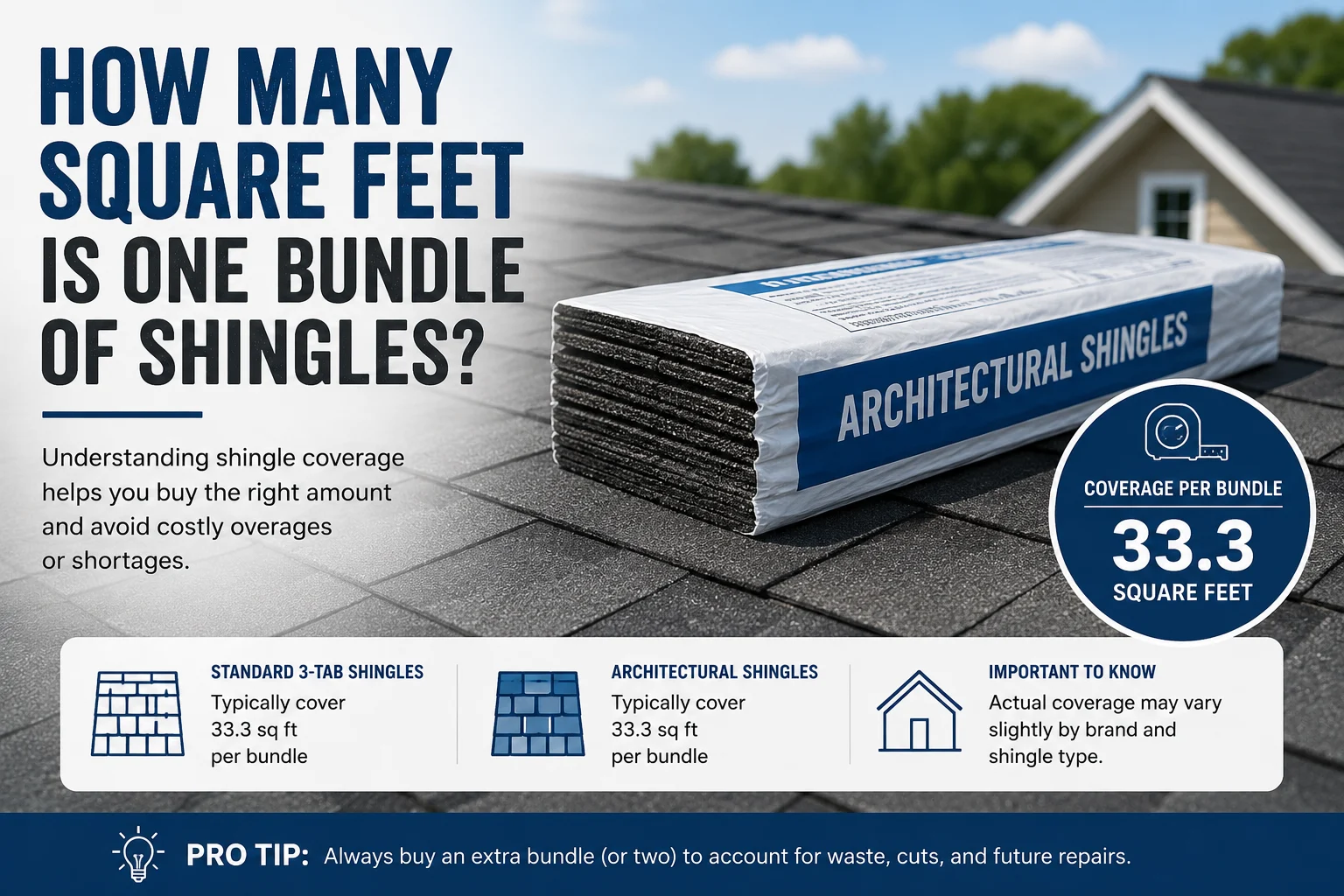
In most cases, one bundle of asphalt shingles covers about 33 square feet. Since a roofing square equals 100 square feet, it usually takes three bundles of shingles to cover one roofing square.
However, the exact coverage can vary depending on the type of shingles, the manufacturer, roof design, and waste factor. Understanding these details can save you money, reduce material shortages, and help you estimate roofing costs more accurately.
This guide explains everything you need to know about shingle bundle coverage, roofing calculations, and common estimating mistakes.
Understanding Roofing Squares
Before calculating shingles, it helps to understand a basic roofing term: the roofing square.
A roofing square is a unit used by contractors and manufacturers.
1 roofing square=100 square feet
Roofers rarely discuss roofs in total square feet. Instead, they measure roofs in squares because it simplifies estimating materials.
For example:
- A 1,000-square-foot roof equals 10 roofing squares
- A 2,500-square-foot roof equals 25 roofing squares
Most asphalt shingles are packaged so that three bundles equal one roofing square.
How Many Square Feet Does One Bundle of Shingles Cover?
The standard answer is simple:
1 bundle of shingles≈33.3 square feet
That means:
- 3 bundles = 100 square feet
- 6 bundles = 200 square feet
- 30 bundles = 1,000 square feet
This applies mainly to standard asphalt shingles.
However, not all shingles are identical. Some premium shingles are thicker and heavier, meaning fewer shingles fit into each bundle. In those cases, you may need four or even five bundles per square.
Standard Roofing Coverage
| Shingle Type | Bundles Per Square | Coverage Per Bundle |
|---|---|---|
| 3-Tab Shingles | 3 | About 33 sq ft |
| Architectural Shingles | 3–4 | 25–33 sq ft |
| Luxury Shingles | 4–5 | 20–25 sq ft |
Always check the manufacturer’s specifications before purchasing materials.
Shingle Bundle Coverage Chart
The table below shows common roofing calculations.
| Roof Size | Roofing Squares | Bundles Needed |
|---|---|---|
| 100 sq ft | 1 | 3 bundles |
| 500 sq ft | 5 | 15 bundles |
| 1,000 sq ft | 10 | 30 bundles |
| 1,500 sq ft | 15 | 45 bundles |
| 2,000 sq ft | 20 | 60 bundles |
| 2,500 sq ft | 25 | 75 bundles |
These numbers assume standard asphalt shingles with minimal waste.
Types of Shingles and Their Coverage
Different roofing shingles have different coverage rates.
3-Tab Shingles
3-tab shingles are the most basic and affordable option.
Features include:
- Lightweight design
- Flat appearance
- Lower cost
- Easier installation
Coverage is usually straightforward:
3 bundles=1 roofing square
These shingles are common on older homes and budget roofing projects.
Architectural Shingles
Architectural shingles are thicker and more durable.
Benefits include:
- Better wind resistance
- Longer lifespan
- Improved curb appeal
- Dimensional appearance
Coverage varies by manufacturer. Some require three bundles per square, while others require four.
Because these shingles are heavier, bundle weight can range from 65 to 80 pounds.
Luxury Shingles
Luxury or designer shingles are premium roofing products designed to mimic slate or cedar shake roofs.
They offer:
- High-end appearance
- Superior durability
- Better impact resistance
However, they typically cover less area per bundle because they are much thicker.
Some luxury shingles need:
- 4 bundles per square
- 5 bundles per square
Always review packaging carefully.
How to Calculate How Many Shingle Bundles You Need
Estimating shingles is easier than many homeowners think.
Follow these steps.
Step 1: Measure Your Roof Area
Measure the length and width of each roof section.
Then calculate the area:
Roof Area=Length×Width
Example:
- Roof section length = 40 feet
- Roof section width = 30 feet
Calculation:
40×30=1200 square feet
Step 2: Convert Square Feet Into Roofing Squares
Next, divide total square footage by 100.
Roofing Squares=100Total Square Feet
For a 1,200-square-foot roof:
1001200=12 roofing squares
Step 3: Calculate Bundles Needed
Multiply roofing squares by bundles per square.
For standard shingles:
12 squares×3=36 bundles
So, a 1,200-square-foot roof usually requires about 36 bundles.
Step 4: Add a Waste Factor
Roofing projects always produce waste from:
- Cutting shingles
- Valleys
- Roof hips
- Starter rows
- Ridge caps
Experts recommend adding:
- 10% waste for simple roofs
- 15%–20% for complex roofs
Waste formula:
Total Materials=Required Bundles×1.10
For 36 bundles:
36×1.10=39.6
Round up to 40 bundles.
Example Roofing Calculations
Here are some practical examples.
Example 1: Small Garage Roof
Garage size:
- 20 ft × 20 ft
Calculation:
20×20=400 square feet
Roofing squares:
100400=4 squares
Bundles needed:
4×3=12 bundles
Add waste:
- Final estimate = 13–14 bundles
Example 2: Medium Home Roof
Roof area:
- 1,800 square feet
Roofing squares:
1001800=18 squares
Bundles needed:
18×3=54 bundles
With 10% waste:
54×1.10=59.4
Estimated total:
- 60 bundles
Example 3: Steep or Complex Roof
Complex roofs need extra materials because of additional cuts and waste.
For a 2,000-square-foot steep roof:
Base estimate:
1002000×3=60 bundles
Add 15% waste:
60×1.15=69 bundles
Final estimate:
- About 69–70 bundles
Factors That Affect Shingle Coverage
Several things can change how much area one bundle covers.
Roof Pitch
Steeper roofs have more surface area than flat roofs.
Even if a home footprint measures 1,500 square feet, the actual roof area could be much larger because of slope.
Waste and Cuts
Complex roof designs create more scrap materials.
Roofs with many:
- Valleys
- Dormers
- Skylights
- Hips
- Chimneys
will require additional shingles.
Starter Shingles
Starter strips are installed along roof edges before the main shingles.
These materials increase total bundle requirements.
Ridge Cap Shingles
Ridge caps protect roof peaks and improve ventilation.
Some contractors use regular shingles for ridge caps, while others use specialized products.
Either way, they add to material needs.
Common Mistakes When Estimating Shingles
Many DIY roofers underestimate roofing materials.
Avoid these common errors.
Ignoring Roof Slope
A roof’s footprint is not the same as actual roofing area.
Always account for pitch.
Forgetting Waste Factor
Ordering exact material quantities is risky.
Without extra bundles, you may run short during installation.
Buying Different Dye Lots
Shingle colors can vary slightly between manufacturing batches.
Buy all bundles at the same time whenever possible.
Using Incorrect Bundle Counts
Not all shingles use three bundles per square.
Premium products may require more.
Check packaging carefully.
Expert Tips for Buying Roofing Shingles
Professionals use a few simple tricks to avoid expensive problems.
Buy Extra Bundles
Ordering 1–2 extra bundles is smart.
Extra shingles help with:
- Future repairs
- Storm damage
- Installation mistakes
Compare Manufacturer Warranties
Roofing warranties vary widely.
Look for:
- Wind protection
- Algae resistance
- Lifetime coverage
- Transferable warranties
Match Roofing Accessories
Use compatible:
- Underlayment
- Ridge caps
- Ventilation systems
- Ice and water shields
This improves roof performance and warranty compliance.
Consider Climate Conditions
Choose shingles designed for your local weather.
For example:
- High-wind areas need stronger shingles
- Hot climates benefit from reflective roofing
- Cold climates require ice protection
FAQs
How many square feet does one bundle of shingles cover?
Most standard asphalt shingle bundles cover about 33 square feet.
How many bundles of shingles make one roofing square?
Typically, three bundles equal one roofing square, which covers 100 square feet.
How many bundles of shingles do I need for a 2,000-square-foot roof?
A standard 2,000-square-foot roof usually requires around 60 bundles, plus extra for waste.
Do architectural shingles cover the same area as 3-tab shingles?
Not always. Some architectural shingles require four bundles per square instead of three.
Should I buy extra roofing shingles?
Yes. Most experts recommend buying 10% extra for waste and future repairs.
Conclusion
So, how many square feet is one bundle of shingles? In most cases, one bundle covers approximately 33 square feet, and three bundles cover one roofing square or 100 square feet.
However, the exact amount depends on the shingle type, roof complexity, slope, and manufacturer specifications. Calculating roofing materials carefully helps prevent shortages, saves money, and keeps your roofing project on schedule.
Whether you are replacing a small garage roof or estimating materials for a full home renovation, understanding shingle bundle coverage is essential for accurate planning and successful installation.
Discover More Articles
How Many Square Feet Is 10×11?